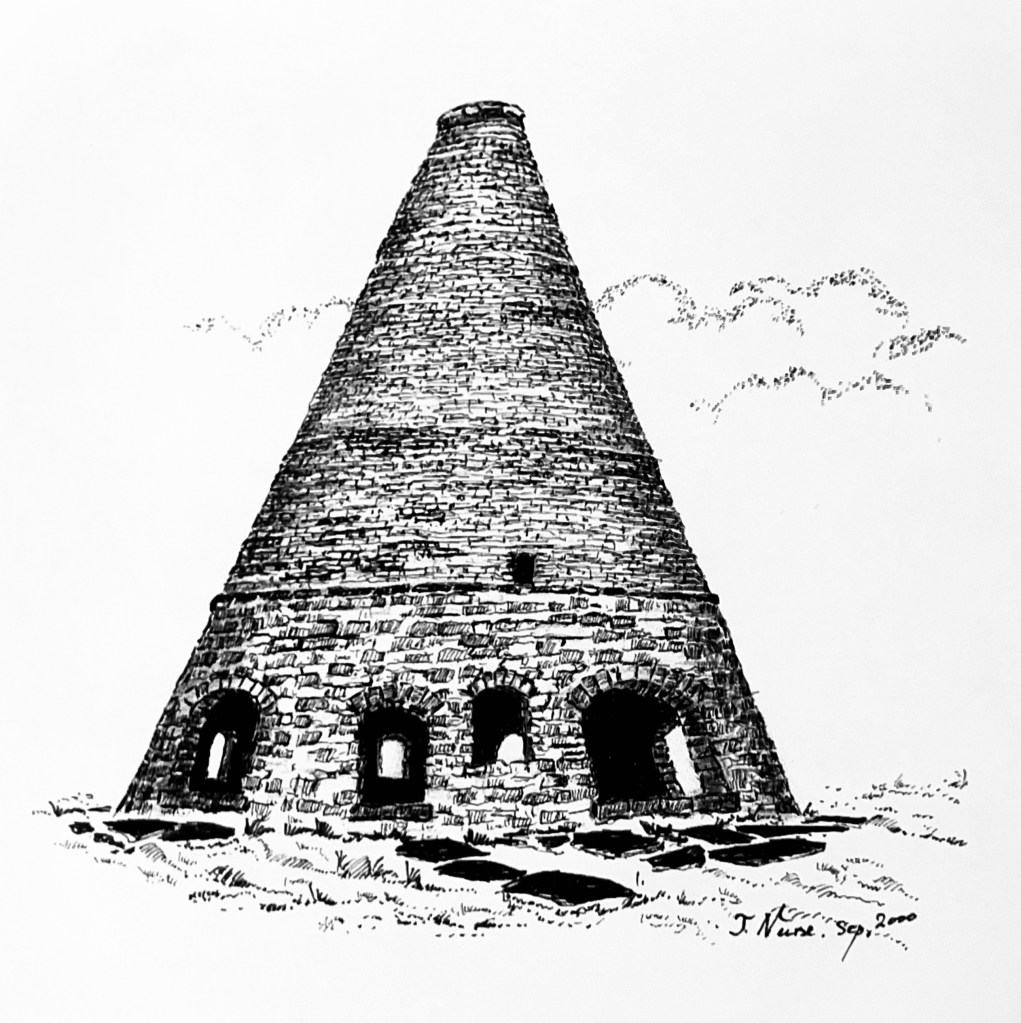
Richard Dixon (senior) was born in Stourbridge in 1665 where George Fox had built the first glass furnace around 1650. Richard learned the art of glass making at Fox’s glass works in Stourbridge.
Fox had moved to Sheffield in 1670 to build a large glass house to produce glass for the Master Cutlers Company. In 1690 Richard, his wife Elizabeth and two sons moved to Sheffield to join George.
When George died in 1699 Richard bought up the lease for Thorpe Farm Whittington in 1702 and built his own glasshouse and furnace. The site was placed well for access to coal, ironstone and building stone. Sand was brought in via the main Whittington – Eckington Road.
Richard began producing glass from around 1710 and he used his considerable skills to produce bottles in a range of sizes and shapes. The company was just beginning to grow when Richard died in 1727.
Richard was succeeded by his son, also called Richard and assisted by his younger brother William.
In the early days of glassmaking it was a hazardous business and Richard died aged 46 in 1736 and William died 7 years later in 1743.
Richard had 2 sons and the youngest, also named Richard took control of the glasshouse whilst the eldest Gilbert became clerk to The Master Cutlers Company in Sheffield. The link proved invaluable and lasted for 26 years until 1769 when Gilbert took control of the company on the death of Richard with his young nephew John Dixon.
By this time the Dixons owned two collieries at Hundall and Whittington, a stone quarry and an iron stone mine. Gilbert carried on building the company until his death in 1777. At this point John Dixon really built up the business and by 1779 was said to be producing the finest cut glass in the north of England. Glass was being sold to some of the finest families including the Sitwells at Renishaw Hall.
The business was able to prosper with the opening of the Chesterfield to Stockwith Canal in 1777, John made use of the canal for the next 40 years to transport coal, glass and ironstone. In 1778 he was appointed resident engineer and was responsible for the construction of branch lines to feed, quarries, mines and factories.
In 1796 he built a road from the glasshouse down to the canal where he built a wharf for the barges to tie up and unload, he later built a narrow gauge railway to link to the canal which became known as Dixon’s Wharf.
John became a wealthy man buying up land in Whittington and surrounding areas as it became available. John became Lord of the Manor.
John died in January 1816 and in his will he left the majority of his estate to Henry Offerton, who later changed his name to Dixon.
Henry was responsible for developing Whittington Hall and its grounds.
No one is sure when the glasshouse ceased production but it is thought to be around 1810/12.
Extracts from the Will of Richard Dixon. 1718-1769.
Grandson of the first Richard Dixon.
I give and devise unto my God daughter Abigail Naylor all that my house with the buildings and appurtenances there unto belonging, and also
the orchard yard and croft adjoining called Webster’s House and croft situated and being in Whittington aforesaid. Which said premises I lately purchased of W. Samuel Foxlow and W. Joseph Emerson to hold to the said Abigail Naylor her heirs and offspring’s forever.
Webster’s house is still in Church Street Old Whittington, and may be the one mentioned.
Also I give and devise unto my brother Gilbert Dixon and my nephew John Dixon and to their heirs forever my two closes lying in Whittington aforesaid called “The Old Acres.”
Also I give devise and bequeath unto the said Gilbert Dixon and John Dixon my two small tenements or dwelling houses at the bottom of the common below the Glasshouse, in the occupation of Thomas Froggatt and Revell Linacre with the gardens and appurtenances to the same belonging in trust to permit and suffer
Mary Dixon, the widow of my nephew Richard Dixon deceased, to take and receive the rents of the said houses to enable her the better to maintain and bring up her two children Hannah and Oliver Dixon until they shall be of fit age to go out apprentice and into service. And then it is my will and mind that the said Gilbert Dixon and John Dixon and the survivor of them his executors and administrators shall sell and dispose of the two said houses, and do give and divide the purchase money equally between the said two children in order to put them out into the world.
Next he gives to Gilbert Dixon and John Dixon Thorpe Farm with all its stock. (Now Glasshouse Farm) The Colliery with all implements, and his Glasshouse.
And I desire my said nephew John Dixon to be at all times kind to his father my brother Isaiah Dixon. (This statement shows that there may have been some problems between John Dixon and his father.)
He wanted the Glasshouse to continue, and states next that if the two above didn’t want to run it, he would like it to be sold, preferably to his cousin John Naylor who was a Glassmaker there.
 Whittington-History