Introduction.
In most places local history is centred around the church, as this is usually the oldest building, and generally steeped in history. In our parishes the two churches are only just over one hundred years old, therefore to some visitors a little disappointing. But an older church did exist. Unfortunately, all we have of this old church are documents to read and copy from and these are spread around in various libraries and public buildings. However, I have endeavoured to find as many documents and information as I can about the old church and put them together in this one little book. Hopefully this will show that Whittington church did have an abundance of history. I hope this chapter will verify this as you flick through the following pages.
It is interesting to think that when the old church was pulled down it was virtually seven hundred years old, this makes our two churches today just babies at the side of it.
THE NORMAN CHURCH OF WHITTINGTON.
Few facts are known about the old church during its early years from 1100 to 1600, and therefore a lot of assumptions have been made by various historians, including Dr. Pegge, who was rector of Whittington from 1751 to 1796. In this early period we must include Whittington with Chesterfield, as Chesterfield was the parish which Whittington was a part. The Chesterfield church existed at least from 1093, as it was given about this date, along with its chapels to the Dean of Lincoln by William the second. From the Doomsday survey of 1086, we can see that there could only have been two or three farms in Whittington, and obviously not enough people of any importance to have built a chapel here.
A list of Priests and Rectors from the old Church.
Compiled from the archives of Lincoln Cathedral
- 1219 Alveredus or Alfred
- 1220-35 Raduiph, Cannon of Beauchief
- 1302 Roger de Mablethorpe
- 1313 John de Kaynes
- 1315 Gilbert de Middleton (Granted leave of absence for study
- 1332 Michael, son of John de Haynton
- 1333 John de Scrobby
- John, son of William de Waynfleet
- Richard FitzJohn This is who was named on the sanctum bell
- 1349 Roger de Walton
- 1354 Ralph de Fynderne
- 1369 Thomas de Lowedon
- Thomas de Bulcote
- Roger Cryche (Interred in the Chancel)
- 1414 Roger Shawe
- 1432 Robert Deye
- 1452 Robert Page
- 1479 Robert Foljambe
- William Walley
- 1487 James Beresford (James was Rector of Chesterfield 1484-1500)
- 1493 John Lytton
- Walter Ireton
- 1530 Nicholas Roberts
- 1531 John Lawrence
- 1600 Robert Croft M.A.
- 1626 John Wolfindale (Whittington split from Chesterfield in 1632) (The first registers started in 1642) John Wolfindale died June 11th 1650.
- 1650 James Hewitt (The first free school founded.) (James died November 14th 1685)
- 1685 Thomas Callice B.A. (His family grave can be seen in the Church Yard) The Church Balcony and North Transept built around this time.
- 1724 Thomas Astley M.A. (Thomas’s grave is in the Church Yard)
- 1751 Samuel Pegge M.A. LL.D (More information can be found re Samuel on this website.
- 1796 William Beecher M.A.
- 1798 Sherard Beecher M.A.
- 1812 George Gordon the elder
- 1816 George Gordon the younger (The last Rector appointed by Lincoln) (He did not live in Whittington)
- 1816 Robert Robinson was Curate in Charge and lived in the Rectory. He was here for 49 years and was licensed in 1823. He oversaw the church demolished in 1863 and a replacement built. It was noted in his obituary that he only left the Parish for 3 nights in his 49 years. He was buried in the Church Yard following a private funeral. His gravestone can be seen the Church Yard.
The next hundred years may have seen the population grow enough, to have seen the beginnings of a small chapel, similar I would think to the Eyre chapel at Newbold, which must have been built about this date. The Eyre Chapel still stands today at the rear of the Nags Head Inn. A chapel of this kind would allow some people to worship locally, instead of travelling into Chesterfield. For christenings, marriages and funerals the parish church would still be used. I might add that Dr. Pegge thought it could have been a rectory as early as 1140, I think it doubtful that a permanent priest would have been here then.
The earliest mention of a priest is in 1219, “Alveredus”, but I think it could have been another hundred years before Whittington had a priest of it’s own. Roger de Mablethorpe may have been one of the first priests to reside in Whittington, as he was reputed to have given some land in the parish to his brother Gilbert. An early priest of some importance was Richard Fitz John, who was here approx. 1340, his name was inscribed on the small bell which hung in a stone frame between the nave and the chancel at the apex of the roof. I would think that this was the first bell that the church had, and could indicate a

A sketch of the actual inscription around the Bell.
restoration or enlargement of the church during his incumbency. Roger Crich was another priest of some importance, he being the rector from 1380-1414, and was interred in the chancel.
I have studied with interest the shields that appeared in the windows around the church. Some of them were reputed to be made of coloured glass, particularly the quartered shield in the south window of the nave. This shield must have been made with the window, and likely to have been inserted when the church was rebuilt from the old English chapel to the Perpendicular style that we see in the sketches by Schnebellie. This shield is quartered with the arms of the Earl of Salisbury, and the Earl of Warwick, the one lord who enjoyed this privilege was Richard Neville the younger. Therefore, from this, the shield could only have been inserted from 1455 to 1477. There were some other shields in the windows, inserted approx. the same date, these being Eyre, Barley, Beckering and Foljambe, it is also worth a mention that a Robert Foljambe was rector in 1479.
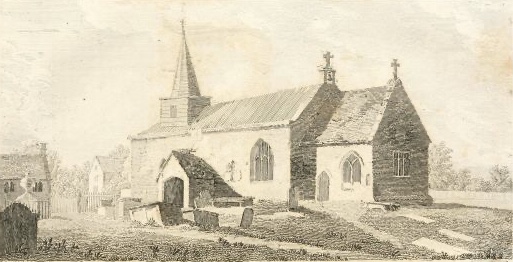
From the above facts, it is easy to conclude that approx. 1460 to 1480, the old English style chapel, must have been largely demolished, and a new Nave built in the Decorated style, completing it with a fine lead sealed roof and tower. This is obviously the church we can see in the drawings by Schnebellie of 1789.
The Dethic shield, in the east chancel window, could have been an earlier date, approx. 1400, this would also coincide with Roger Crich’s slab. The chancel roof seems to be older than that of the nave, and therefore could have been left when the nave was rebuilt. There is more about the Stained Glass windows below.
Richard Neville may have been the last of the medieval lords to own Whittington, many of these landowners never seeing the land that they owned, but relied on their bailiffs to collect their taxes, and administer them.
By the middle of the fifteen hundreds, I would imagine Whittington was becoming quite a prosperous little village, as well as farms, it may have had some landed gentry residing here. The old manor house may have been built by then, although it is doubtful. We know that the church had a large following, and at this point in time must have held approx. 120 people.
The next turning point was when the church split off from the mother church of Chesterfield, which happened in November 1632, when John Wolfindale was rector, although he was regarded as scandalous and insufficient, he started the first registers of the church. Before this most marriages and christenings would be done in the parish church. This could also account for no monuments being found in the churchyard before this date, the earliest one being visible is 1673. With the splitting off from Chesterfield, the church would become more important, with a larger congregation. In 1687, it was found grossly too small. To overcome this, they decided to build a balcony at the west end of the nave to hold another 30 people. It would be about this time that the north door was blocked off, and more pews added opposite the font, bringing the total seating capacity up to approx. 200.
We are fortunate in having the original plan, which was drawn to construct the balcony, or loft as it was called then. The plan shows the roll of seat holders, which was presented to the Bishop of Lichfield for his approval. As most people attended church at this time, it gives some indication of the population of Whittington, which must have been approx. 300. It also shows the shape and size of the church at that date. It is interesting to see that some families had more than one seat, and also to see these seats spread out in the church. Probably so that there was no favouritism of places.
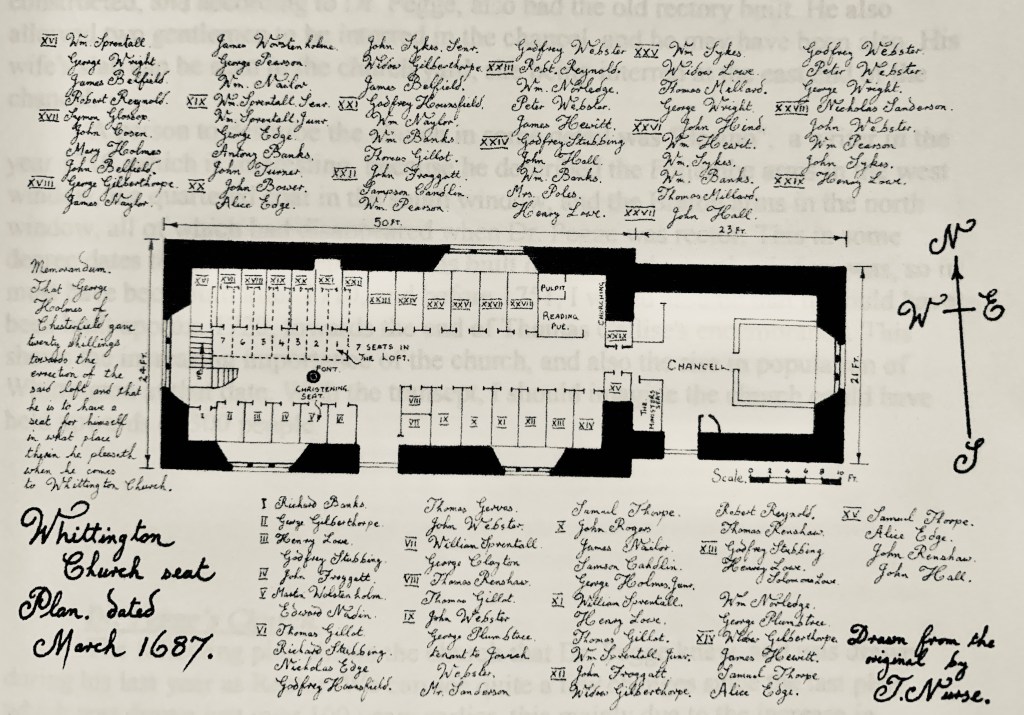
Church seats in those days were paid for in the way of tithes, and so the wealthier families could afford more than one seat. Some of these families bought a seat in the church for their servants.
There are some very interesting names among the list of seat holders. The ones of particular interest to me are:
Mrs. Pole. The Poles were the lords of the manor at that time, this raises a question, was her husband dead, and did she reside in the village?
Godfrey and Peter Webster. The Webster’s were a large family in Whittington, owning quite a lot of land just south of the church. They also provided money to start the first free school in the village.
John Froggatt. I see he had the seat in the chancel, opposite the minister, he was also interred in the chancel therefore must have been someone of importance, but as yet I have failed to find out much information about him.
From the plan we can see where the north door was, note that the north transept wasn’t built then, neither was the porch over the door, although this may not have been included on the plan. Thomas Callice was rector when the balcony was constructed, and according to Dr. Pegge, also had the old rectory built. He also allowed two gentlemen to be interred in the chancel, and he may have been also. His wife’s slab can be seen in the churchyard, she being interred at the east end of the chancel.
A person to describe the church in some detail was “Bassino”, a writer in the year 1710, which is interesting, because he described the Foljambe arms in the west window, the quartered coat in the south window, and the Breton arms in the north window, all of which had disappeared when Dr. Pegge was rector. This in some degree dates the north transept, as it was built out where the north window was, so it must have been built after 1710, and before 1751, I would assume that it would have been built approx. 1720, towards the end of Thomas Callise’s incumbency. This shows the increasing importance of the church, and also the rise in population of Whittington at that date. With the transept, I should imagine the church could have held upwards of 300 people.
The following plan shows the church that Dr. Pegge knew, and was drawn during his last year as Rector. We can see quite a few changes since the last plan, which was drawn just over 100 years earlier, this mainly due to the increase in population of the village.
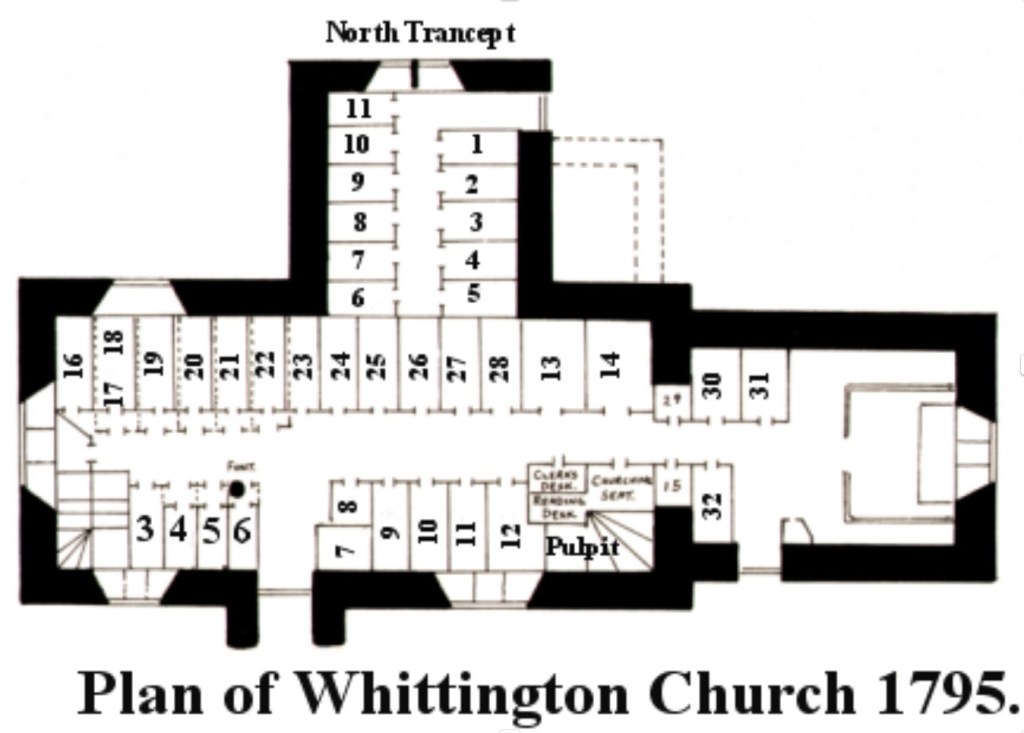
As can be seen the pulpit was changed over to the other side. An extra window was added to the north side, this obviously to let more light onto the balcony. It is interesting to note that the south chancel window is not shown on any of the plans, verifying the fact that this window was only of small dimensions. The dotted lines indicate a later addition at approx. 1810. This may have been a storeroom or vestry and later may have had some pews in it In the chancel it shows the rails of the communion table, the table is also shown and therefore the alabaster slab of Rodger Crich must have been directly under this. (Or it may be the slab itself.) Samuel Pegge was born in Chesterfield on the 5th of November 1704 and was educated at the Chesterfield Grammar School and St. Johns Collage Cambridge. His parents were Christopher Pegge and Gertrude Stevenson, they were married in Chesterfield in 1702, they had three children Christopher, Samuel and Lydia.
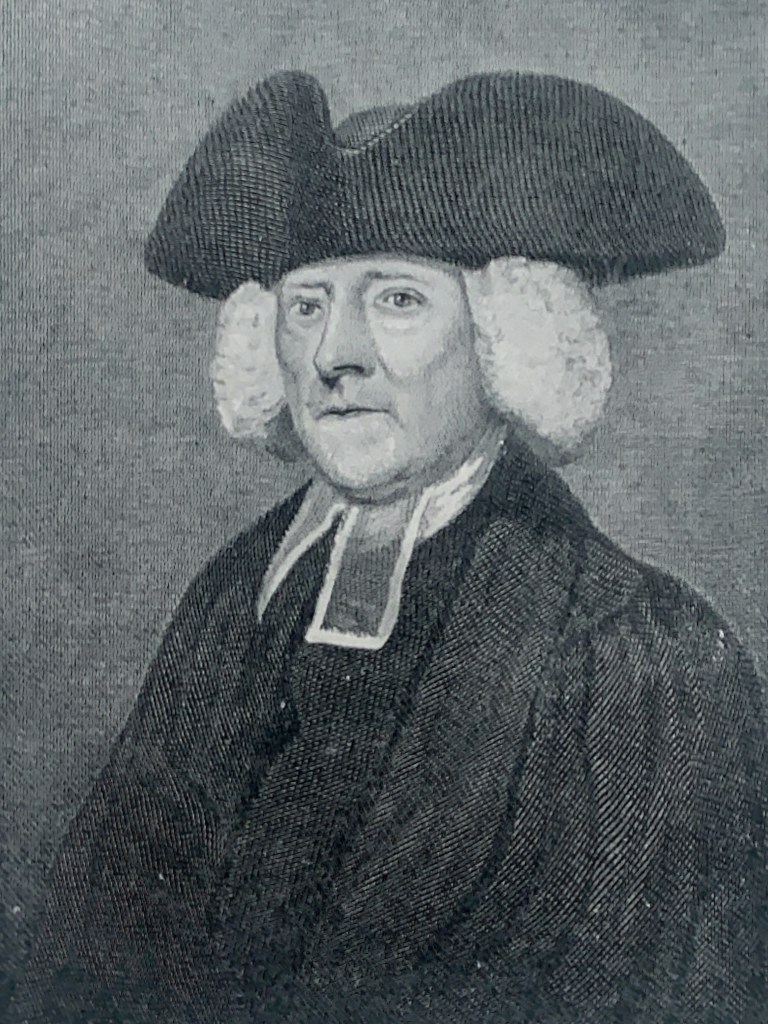
A painted portrait of Dr. Pegge is in the church. The picture is a copy of a painting copied from an engraving, which was sent to Whittington by the Rev. F. B. Allison a descendent of Dr. Pegge, he was the vicar of Peasmarsh Sussex. The engraving was done approx. 1810, and he sent it to Whittington in 1919. The original was sadly destroyed in a fire.
It is a great pity that no thought was given to the history of Whittington when this little, but great church was pulled down. As in it was interred Samuel Pegge and John Dixon, the wealthy Lord of the Manor. Now we have no monuments to remind us of them.
See a seperate page for Sam Pegge under ‘Local People of Interest’
The Church Windows
There were six main windows in the church which have been described quite well by various historians, four of these were in the nave and two in the chancel. By studying the pictures of the church I have been able to piece together what these six windows must have looked like. Note on the picture below the vertical sundial on the wall just above the porch.
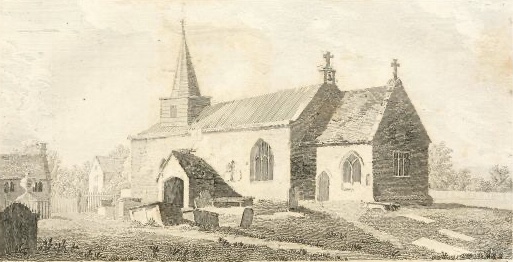
The sketch above is copied from Schnebbelie’s drawing, it shows the two windows in the chancel, and the two south facing windows in the nave. The west-facing window is shown in the drawing on the front cover. Therefore, the only window which isn’t shown is the north window. From the plan of 1687 we do know it was a three light window the same as the others in the nave.
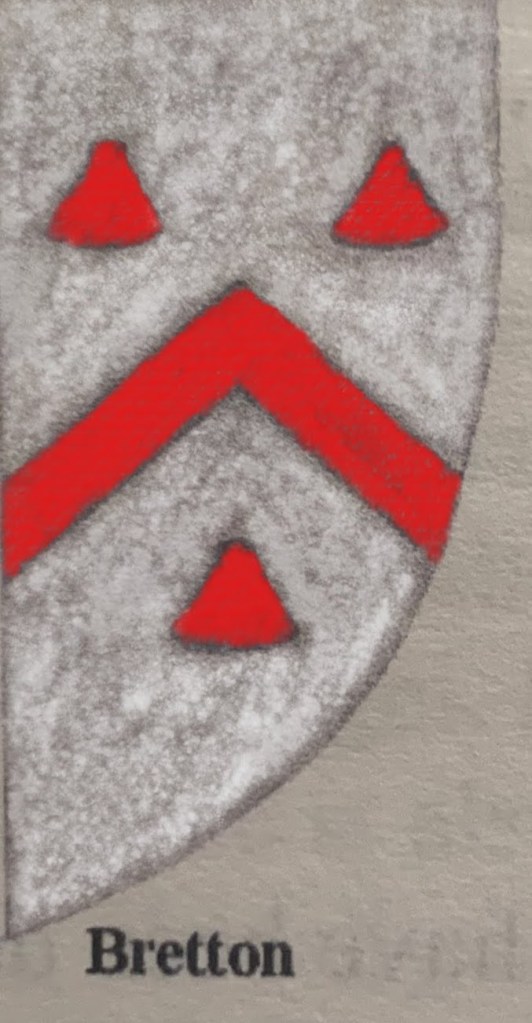
1.The North Window.
This three-light window must have been similar to the others in the Nave and was removed to make way for the north transept. It had a shield in the window which was probably the oldest one in the nave. As can be seen from the drawing it had two coats of arms the left one being illegible, but I would suspect it as being “Loudham”. The right coat of arms is that of “Bretton.” Sir John Loudham married Isabelle, heiress of Robert Le Bretton approx. 1370. One of their daughters married Thomas Foljambe, and the younger daughter married Sir John Beckering, which ties up with some of the other shields in the windows
2. The large West Window.
This window faced the entrance to the churchyard and had in it a coat of arms and a picture of St. John, with a book in his right hand holding the lamb of God. I have shaded the area where these could have been inserted.
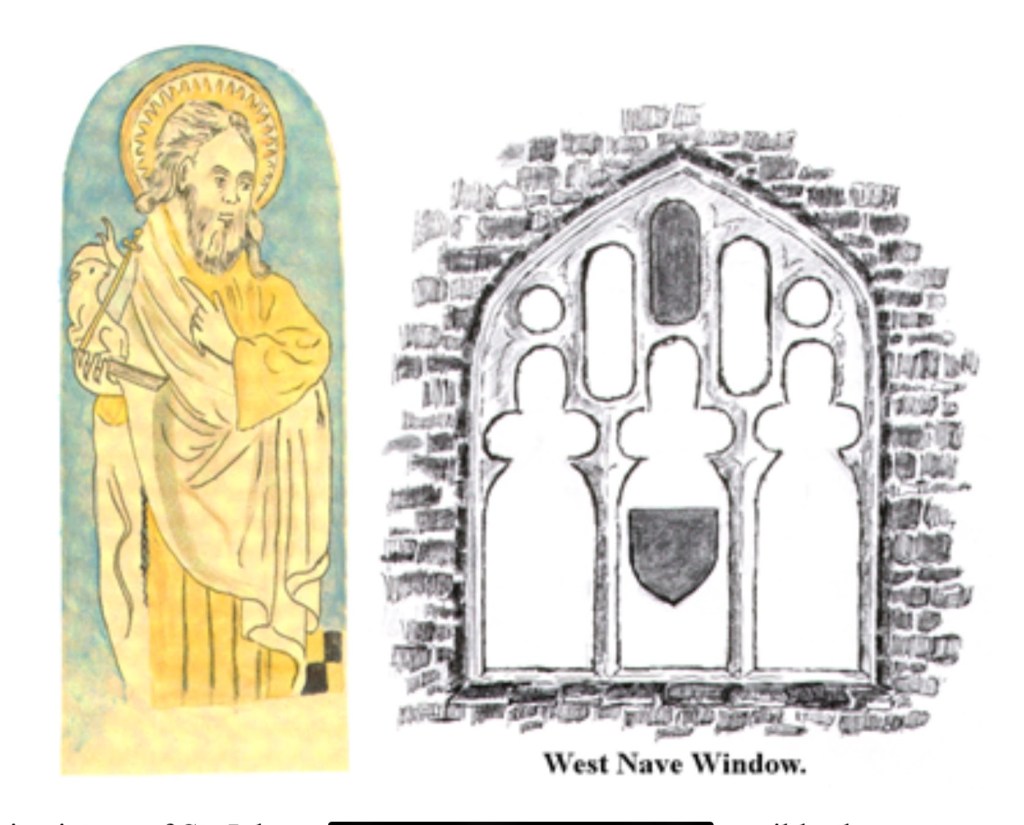
This picture of St. John was in one of the upper tier’s, possibly the centre one as shown. It is similar to the other picture in the chancel, and therefore possibly done by the same person. It was only 600mm long and therefore would have filled the upper tier window.
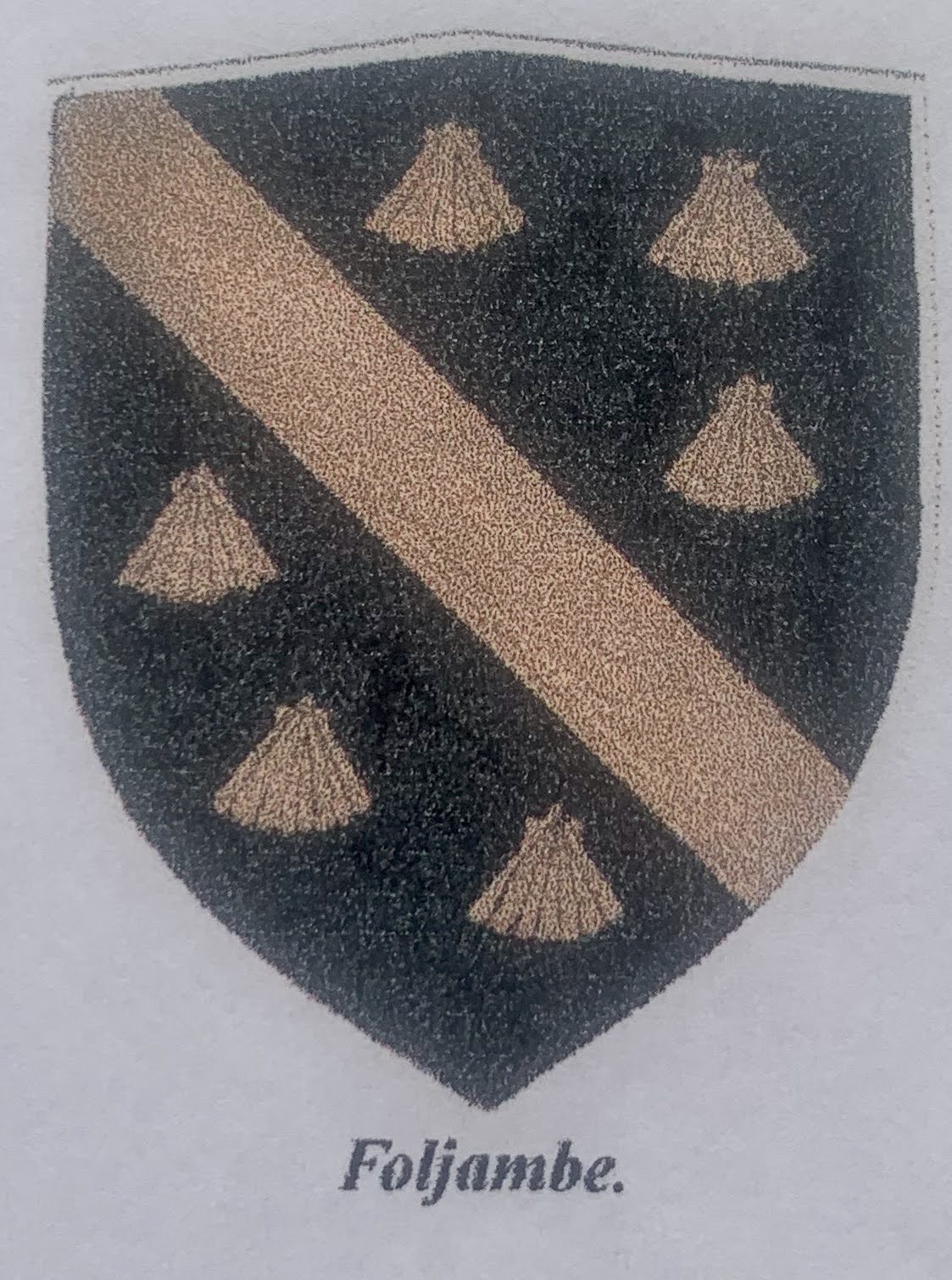
The shield in this window was the Foljambe coat of arms, coloured black and gold. The family owned most of Chesterfield until 1622, first appearing in the 1400s when Sir John Loudham’s daughter married Thomas Foljambe.
3. and 4. The south windows of the Nave.
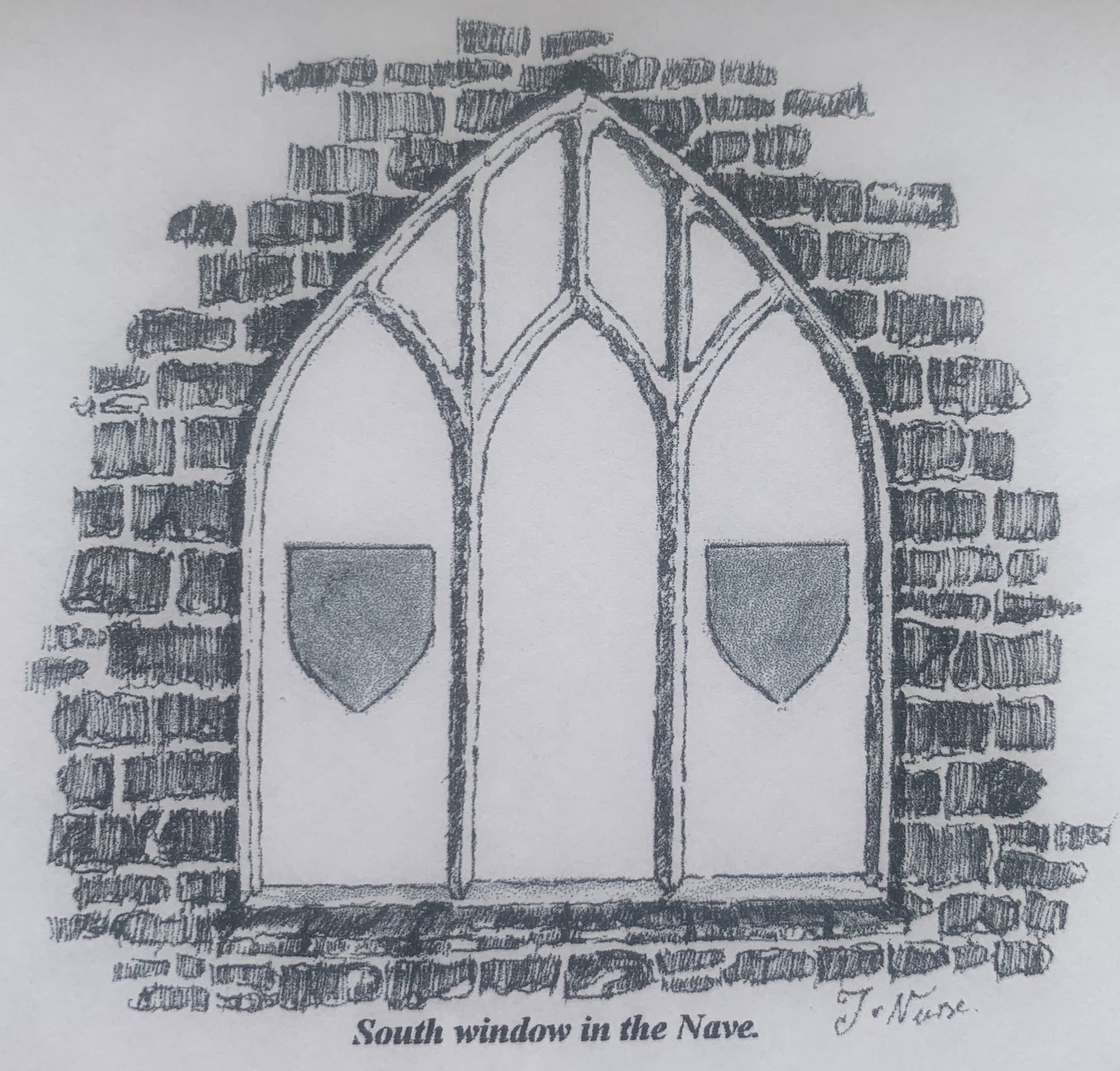
These widows where on each side of the entrance porch, both had three lights. The one on the east side of the porch was the larger of the two. A smaller window was high up on the side of the wall, this would be to give light to the balcony.
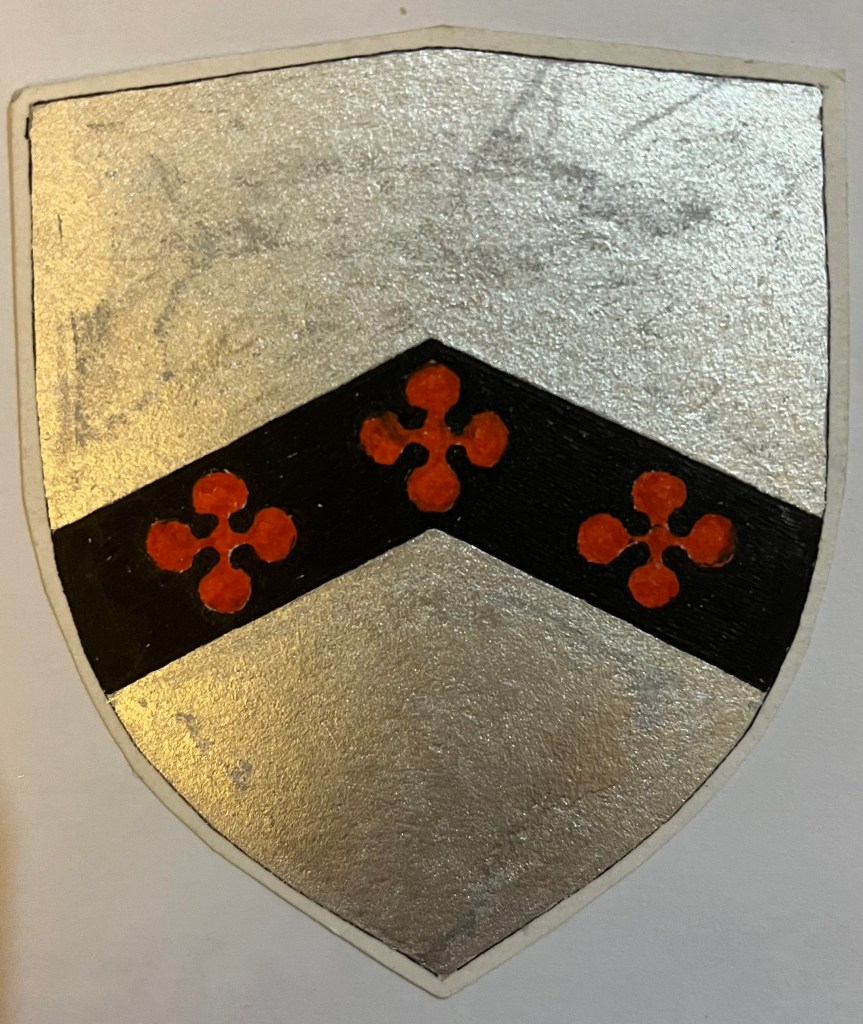
This coat of arms was in the window on the east side of the porch, it is of the Eyre family of Newbold. A Rodger Eyre married Elizabeth Whittington of Whittington approx. 1475. Their great grandson married Elizabeth, daughter of Robert Barley (Barlow) approx. 1510.
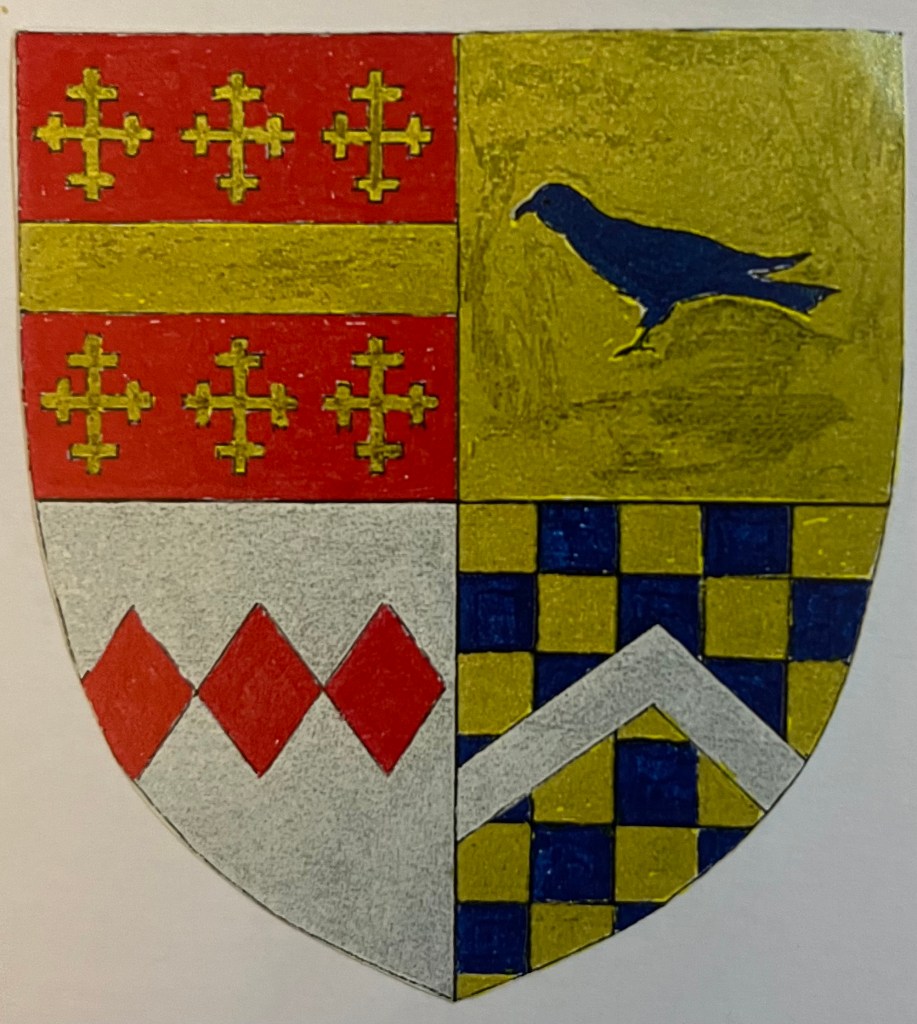
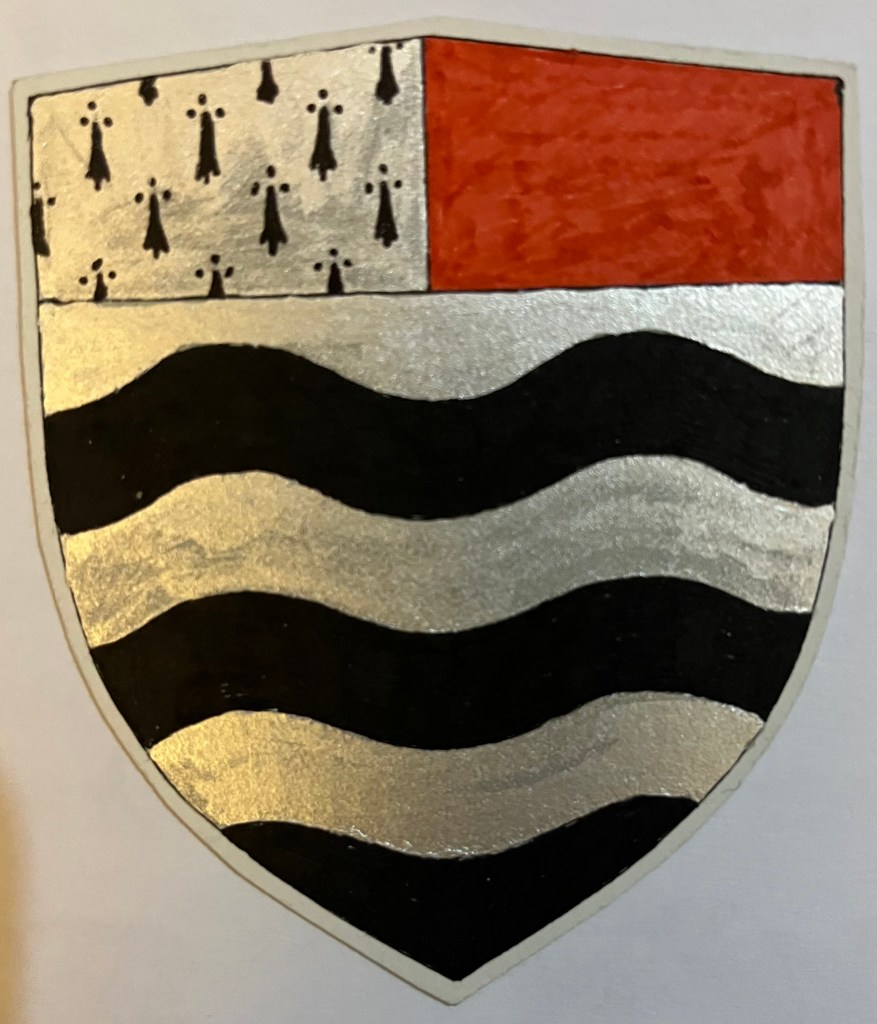
The shield left was displayed in the same window and I have assumed that both shields were in the end lights. It is a quartered shield of the Earl of Warwick and the Earl of Salisbury. Richard Neville II inherited both these about 1470, by marriage of his father and himself. Top left BEAUCHAMP.
Top right and bottom left MONTAGUE. Bottom right NEWBURGH.
5. The South Chancel Window.
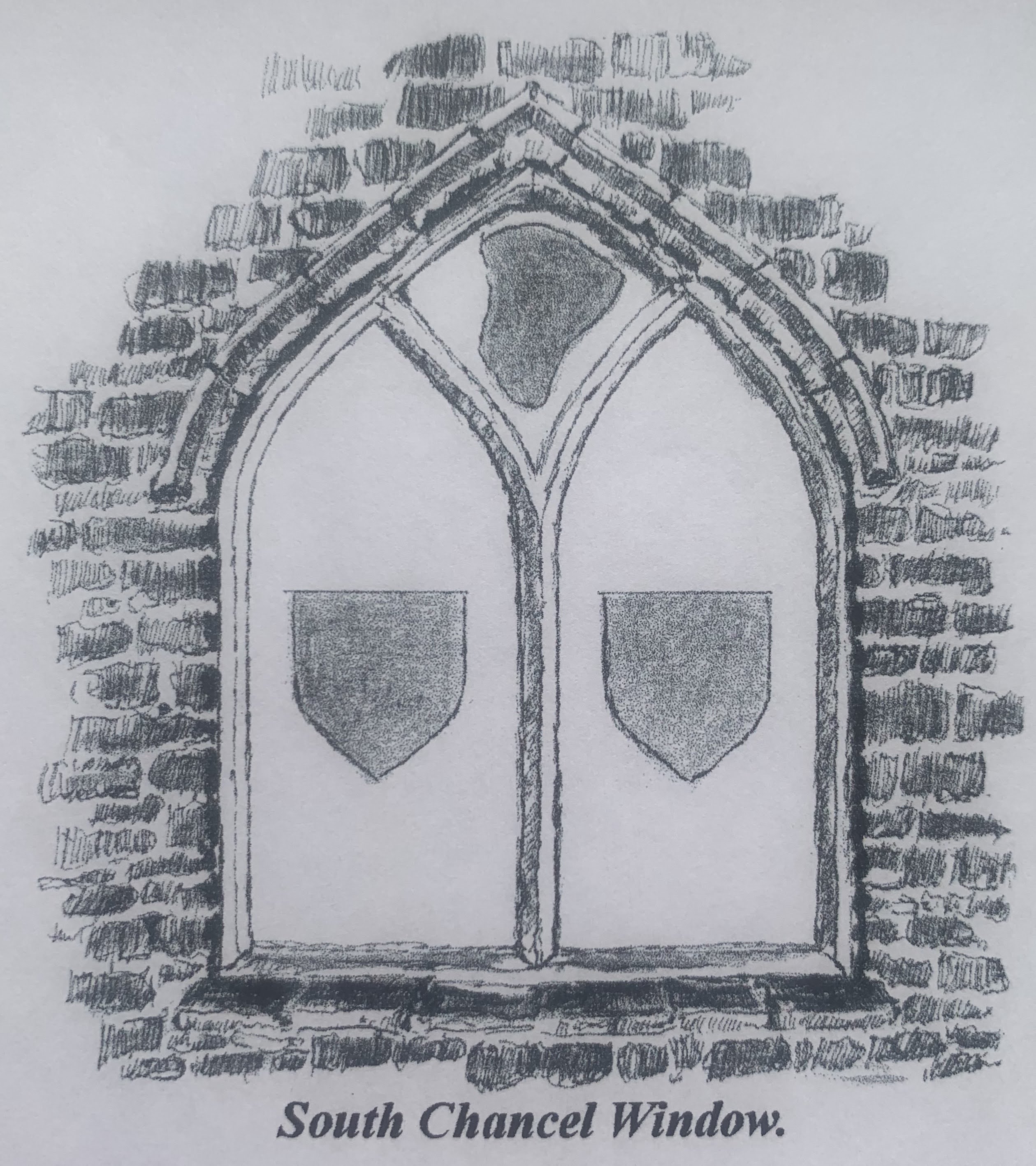
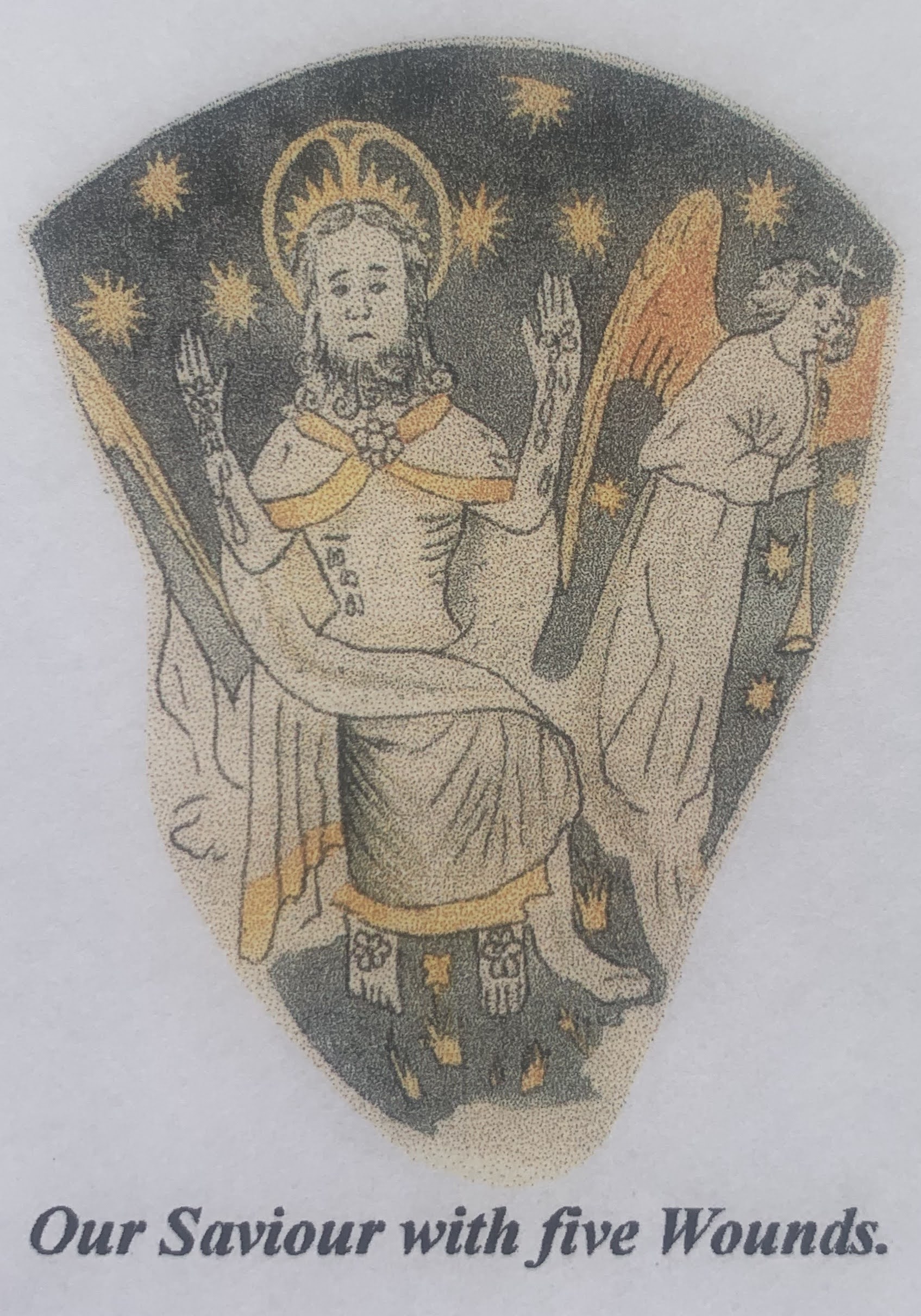
I think it is almost certain that this window is how I have shown it below. The drawing of “Our Saviour with five wounds” was completed by Schnebbele on the 27th. July 1789. There is part of another angel missing on the left, but it clearly fits into the upper tier of that window. The glass window is very old, as can be seen by the style, probably fifteenth century.
The Shields in the Window.
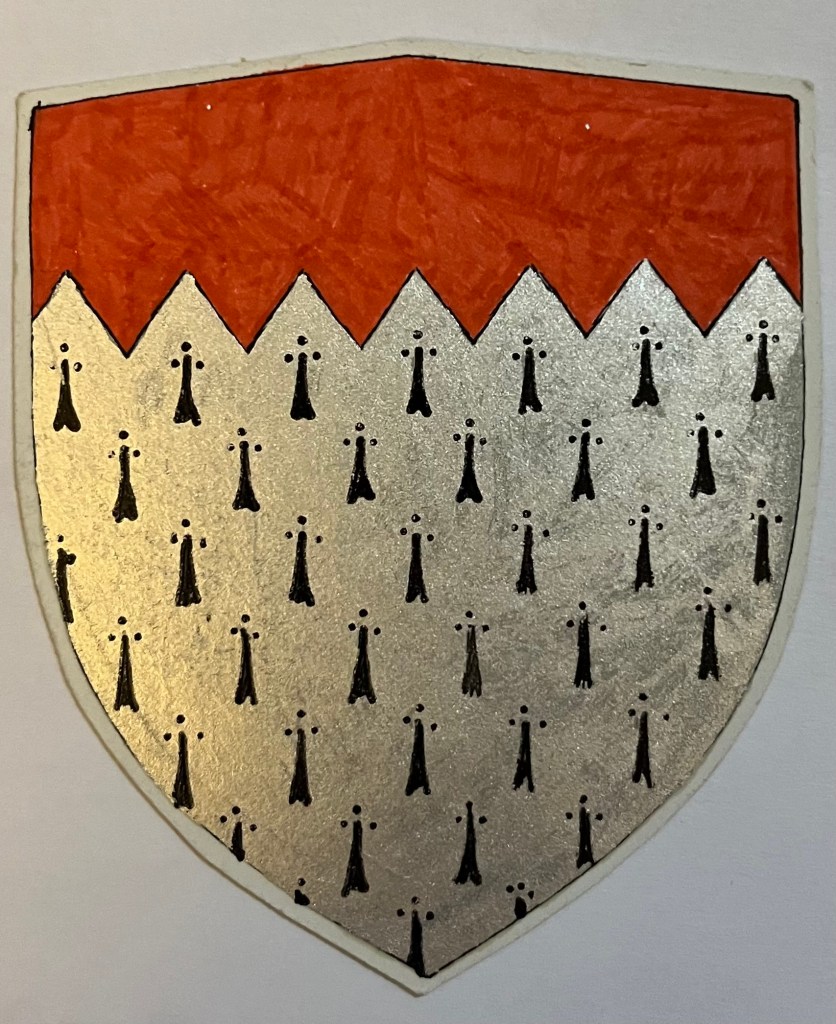
I am a little doubtful about the “Morteyne” shield, although this family may have been intermarried with the Bretton’s.
t could have been a shield belonging to another family.
The other shield “Barley,” which we now call Barlow belonged to the family which owned the adjacent manor to Whittington.
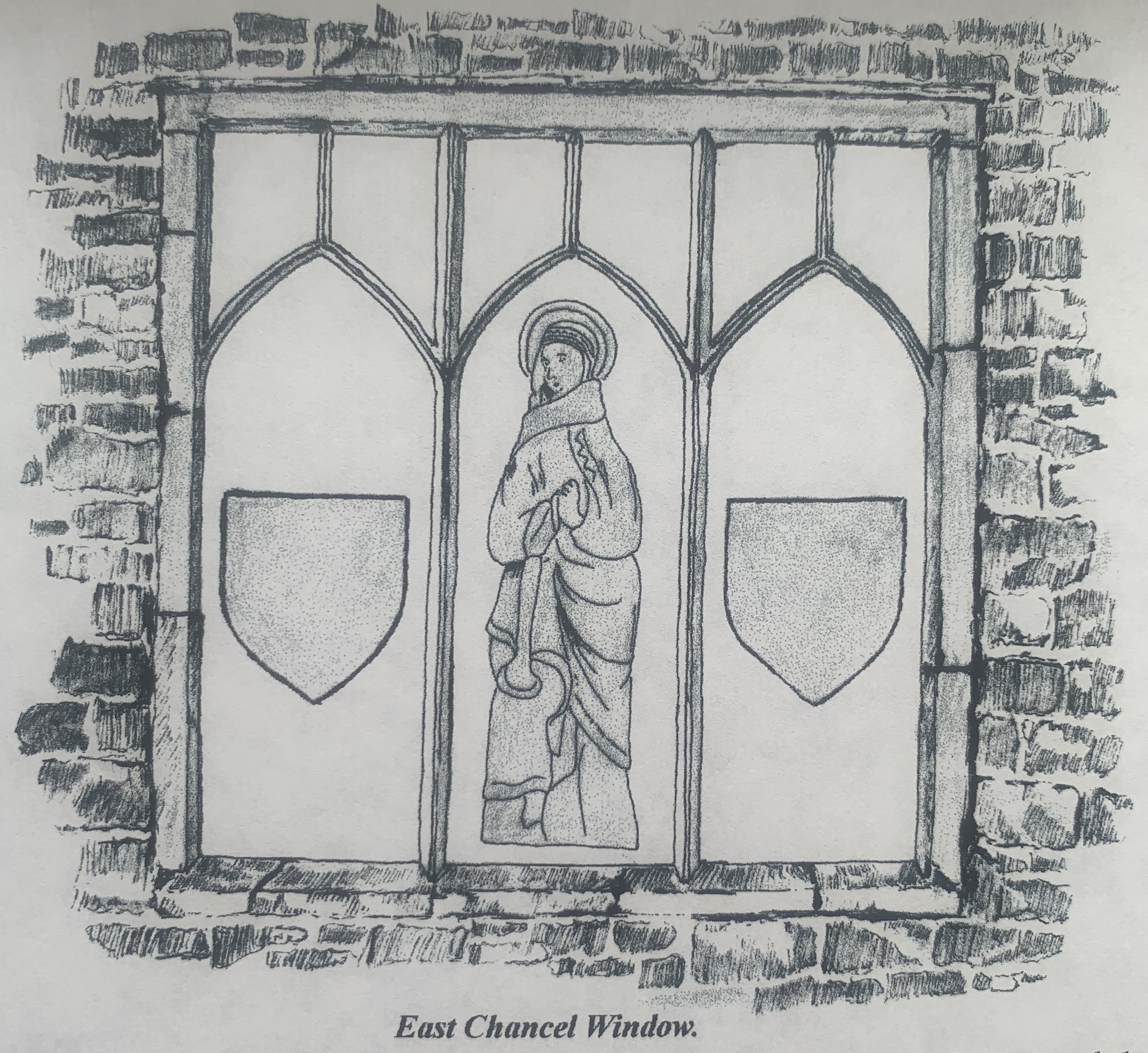
Left is my impression of the window, with the two coat of arms and the picture of the Female Saint that was copied by Schnebbele in 1789. There is no information as two which lights in the window these were displayed, or as to their size.
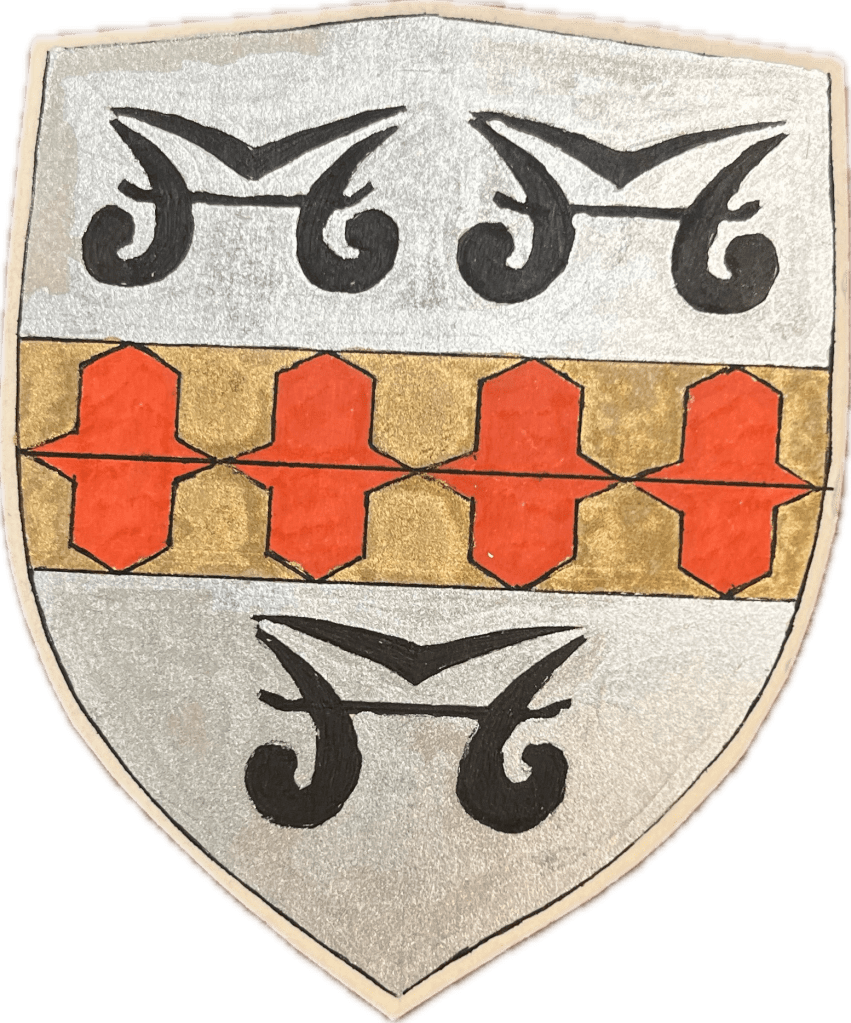
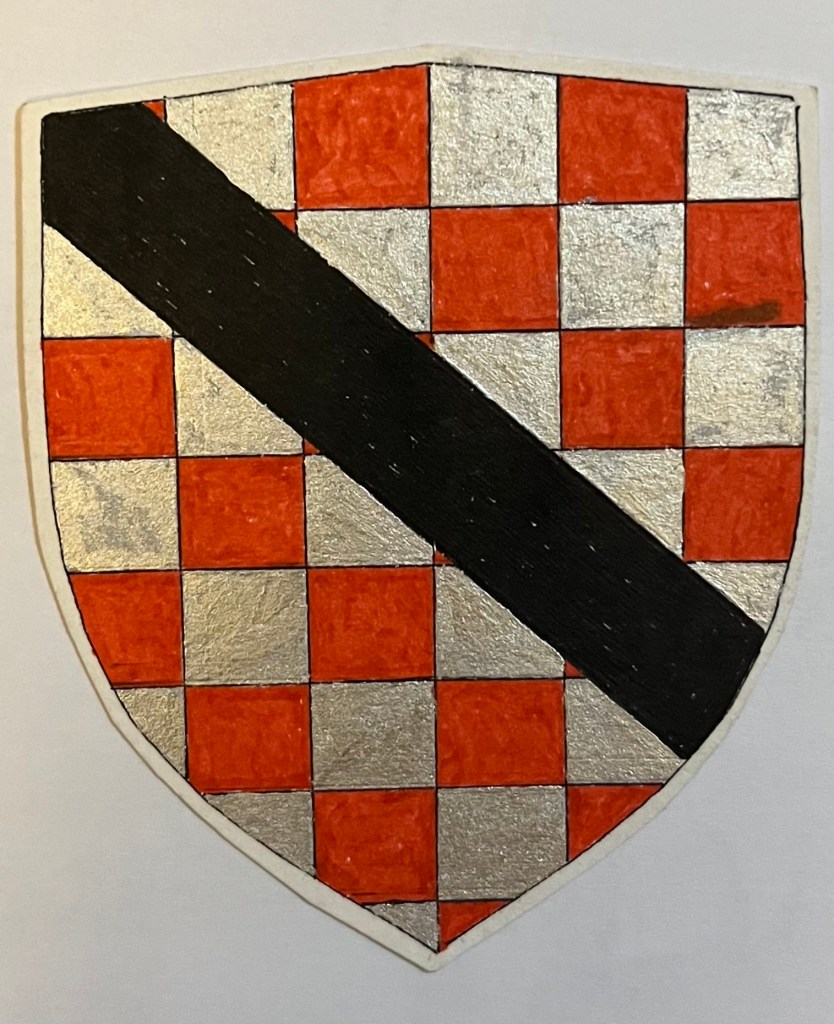
The Dethic family owned Whittington in the 1200’s.
The Beckering family of Walton was intermarried with the Foljambes
The Pegge Shield.
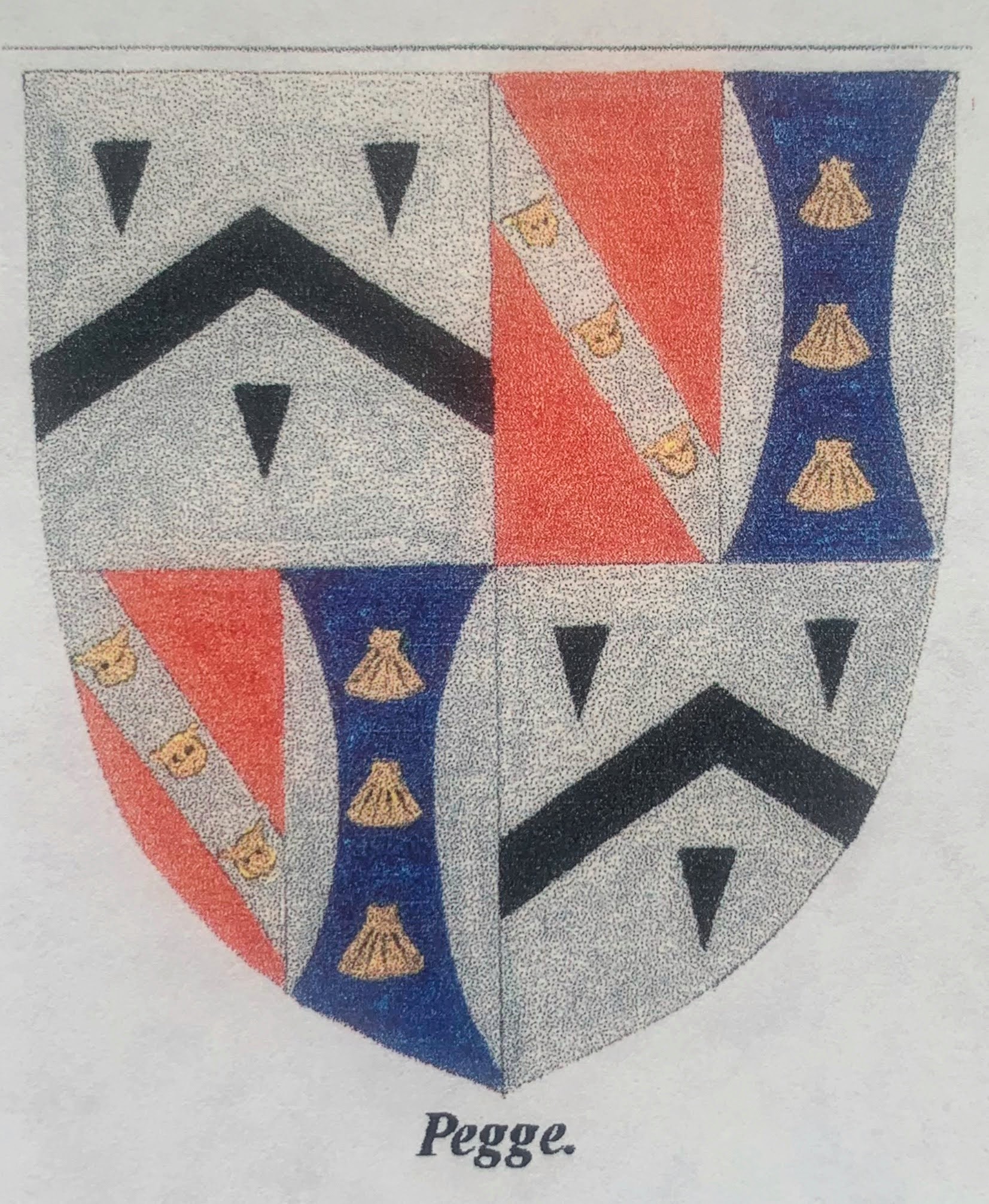
This shield was positioned above the East window of the chancel where he was interred.
Top left and bottom right. PEGGE.
Top right and bottom left. STEVENSON of Unstone.
CLARKE of Stanley, near Wakefield.
I find from records that Samuel Pegge’s mother was Gertrude, the daughter of Frances Stevenson of Unston. Also Samuel Pegge’s wife was Anne daughter of Benjamin Clarke of Stanley near Wakefield.
THE CHURCH ENTERING THE INDUSTRIAL REVOLUTION.
This was the situation of the church under the direction of the two Gordons, who together were the rectors for over sixty years. I think it a pity that these two rectors didn’t reside in the village, one also being the rector of another church. Therefore, not being able to do his full duty here in Whittington
The curate in charge over this important period was the Rev. Robert Robinson, he was dedicated to the church here for over fifty years. Slowly over this period we see the beginning of the end, of the old church. He was the Curate for 49 years and it is reported that he only left the Parish for 3 nights over that period. He continued to live in the Parish after his retirement and officiated at some funerals during this period. On his request he had a private funeral and is buried in the Churchyard.
In 1827, the Rev. G. Gordon had the chancel re-built and possibly extended as we see it on the plan of 1851. Not long after this, it is reported that the church wardens had the old spire pulled down, and removed all the lead from the roof, and sold it, with the intention of erecting a stone tower, and re-roofing the church with blue slate. They hoped to do most of the work, from the sale of the lead. They got the body of the church covered with slate, and then found their funds exhausted, and so the spire on the west end was left on a level with the roof, and the sanctum bell fixed in its stone frame here. The church seemed to be left in this condition, for quite a long period of time till 1851. The bell being a mark for the boy’s to throw stones at. During this period the church was well attended, upwards of 300 people. By this time, they had installed pews in the chancel.
The specification for the new Tower and other alterations is still in existence and was produced by the contractors John Siddall and Thomas Mettam who lived in the village. The work was quite extensive as besides building the Tower, four buttresses were to be put on the sides of the church, a new main door and two stone seats to be installed in the porch. Also, the roof was to be stripped of lead and a new roof put on in Bangor Blue Countess slates. The sale of the lead to go towards the cost. From this specification it appears that the roof was completed in 1851 and not earlier as S. H. Stone suggests in his writings.
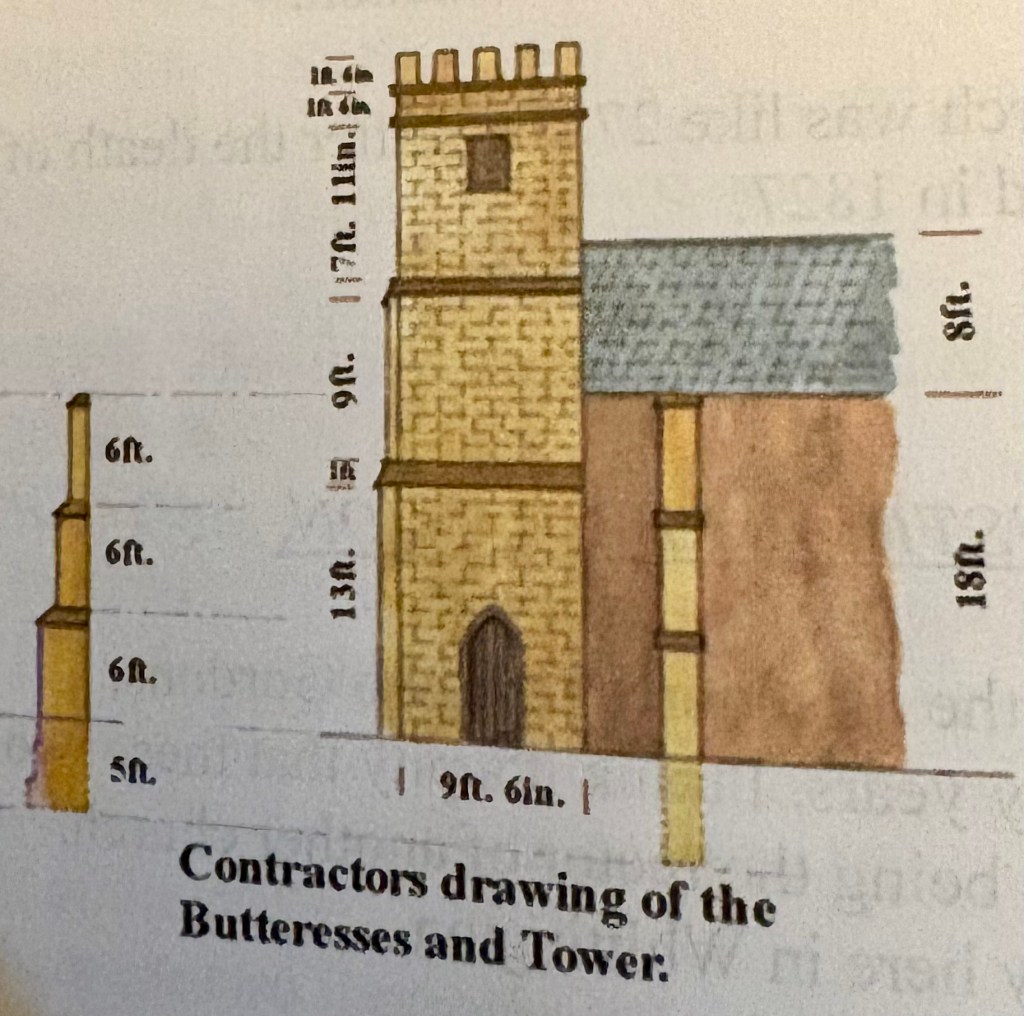
These are the drawings that the contractors produced for the alterations, the brown area on the plan is the new work to be done
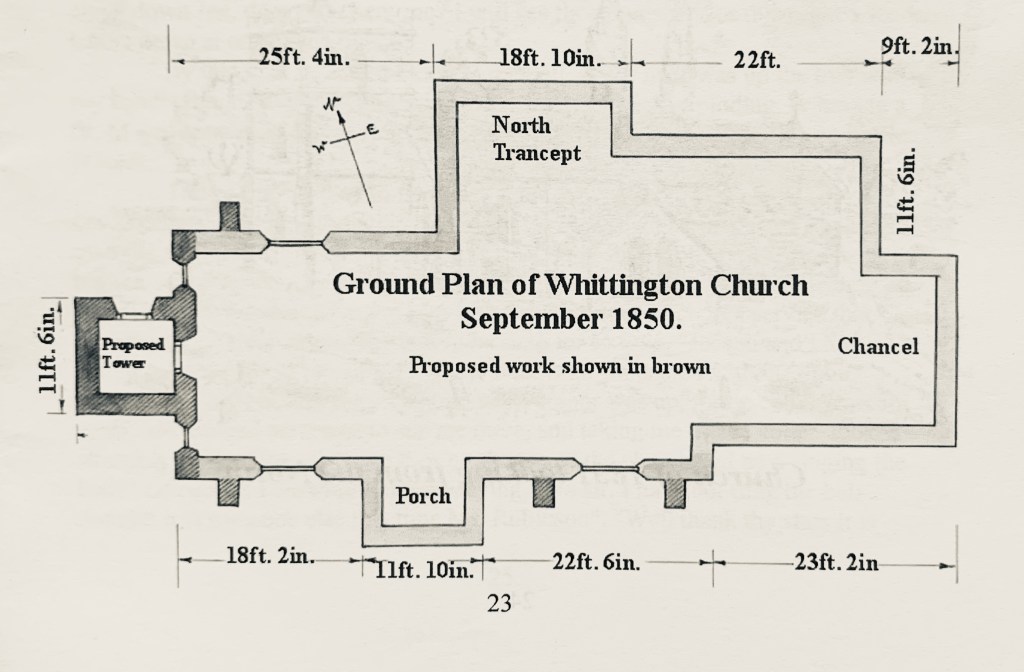
The contractors were to start work immediately the contract was signed, this was done in October 1850 by the two church wardens, Samuel Bower and George Jenkinson. The price for all the work involved was £140 and a completion date was given as Lady Day next.
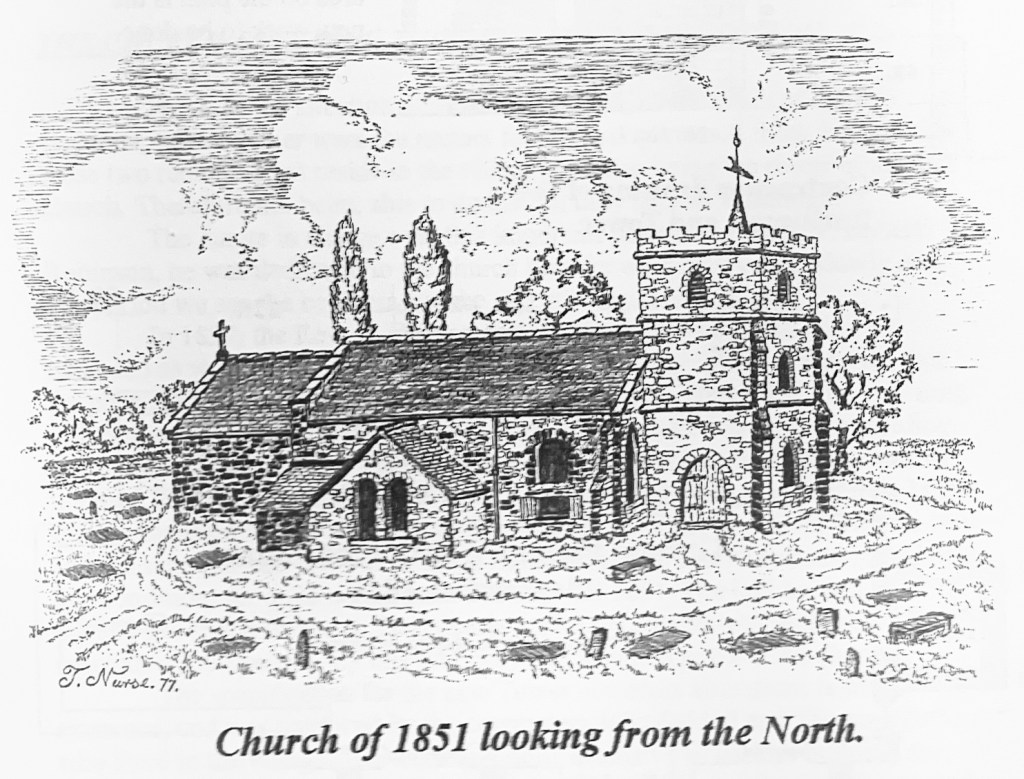
According to S. H. Stone, the new tower was completed, and E. A. Crompton confirms this. The drawing below I have copied from his book, but I don’t know where it originated. The church stayed like this for only twelve years, and then pulled down in 1863. This made way for a much-needed larger church, as from 1851 to 1861, the population trebled.
According to bell ringing records 3 bells were transferred from this church to the replacement which again seems to confirm that the tower was built.
MONUMENTAL INSCRIPTIONS FROM THE CHURCH.
The following was taken out of the Reliquary Vol.6 Jan. 1866. written by J. H. Clarke.M. A. Just before the church was demolished, he made a note of the monuments and inscriptions, which he recorded as follows.
On the south wall of the nave, was a marble monument to;
Elizabeth, wife of John Dixon Esq., died 11th. April 1789 age 35.
John Dixon Esq., died 27th Jan. 1816 age 74.
On the north wall of the nave;
Pym Denton died 22nd Aug. 1820, age 59. Sarah Denton. died 13th Jan. 1833 age 52. Alicia Dale Denton. their second daughter died 3rd June 1828 age 12
On the north wall of the chancel;
John Froggatt, Gent. died 22nd Sep. 1692.
(Interestingly in the graveyard there is a gravestone to a John Froggatt, aged just one year old positioned where we believe is above the North Wall of the Chancel)
On the floor of the chancel;
Here lyeth the body of John Moore of Pillesly, in North Wingfield parish in the county of Derby, Gent. who died 14th April 1704, and left behind him Rose, his then wife, who since intermarried with Robert Gulliver of Eggington, in the said county, Gent.
(This gravestone can be seen in the graveyard. We hope in the future to ascertain whether the floor is near the surface at the East end or whether this sone was disturbed when burying someone at a much later date)
Over the East Window. At the north end of the Alter Table, within the rails;
Lieth the remains of Samuel Pegge, L.L.D.
Who was inducted into the rectory, November 11, 1751.
And died February 14, 1796 in the 92nd year of his age.
The tablet was surmounted by the following arms; Quarterly 1 and 4 Pegge. 2 and 3 Stevenson of Unston impaling Clarke.
The following inscription is on a slab, at the East side of the church.
H.J. Thomas Astley.
Per annos quinque et viginti
Hujus Ecclesiae Rector
Pastorali functus est officio
Cum omni diligentia.
In Cathedra.
Verae religionis stenuus Defensor
Suos ad vitam Christianam
Simplici dicendi vi
Praecipue autem vita et moribus
Impulit
Vixit enim Charitatis and Benevolentiae
Virtutumque omnium Christianarum
Singuare Examplum,
Annos octo et quinquaginta natus
Convulsionibus conflictatus
Per Biduum Obit
Jan. 8 1750.
I must admit I’m not very good with Latin, but with the help of a book I have endeavoured to translate some.
Through the years of five and twenty as Rector of the Church I have shepherded my flock with duty and diligence from the raised seat. I have lived with Charity, Benevolence and Virtuosity. Age eight and fifty.
 Whittington-History