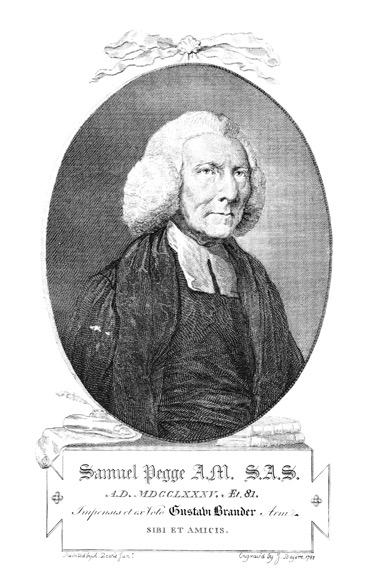
5 November 1704 – 14 February 1796 was an English antiquary and clergyman.
Samuel Pegge was born in Chesterfield in November 1704, son of Christopher and Gertrude. He studied at Chesterfield Grammer School and went on to St. John’s College, Cambridge where he graduated B.A. in 1725 and M.A. in 1729.
He was ordained in 1729, and in 1730 became curate at Sundridge in Kent. He was elected to a lay fellowship on the Beresford foundation of his college on 21 March 1726, but was removed in favour of Michael Burton (afterwards vice-master of St. John’s), who claimed founder’s kin. Pegge was then made an honorary fellow, and in 1729 was elected a “Platt” fellow of St. John’s. In 1730 he was elected a member of the Spalding Society, to which he contributed some papers, and from 1730 to 1732 belonged to the Zodiac Club, a college literary society consisting of twelve members denominated by the signs of the zodiac. Pegged was the original Mars. On 6 December 1731 he became the vicar of Godmersham, Kent, where he lived for about twenty years, writing on antiquities and collecting books and coins. From 1749 to 1751 he lived at Surrenden, again in Kent. In 1751 he was elected fellow of the Society of Antiquaries, and in the same year was inducted into the rectory of Old Whittington a position he held for 45 years.
Following the death of his wife let it be known he would like the opportunity to return to Derbyshire. After a great deal of debate around rights to appoint Samuel Pegge to Brampton in Derbyshire He was licensed by the Bishop of Lichfield. In consequence of this decision and the Bishop’s licence, Mr. Pegge, not suspecting that the contest could go any farther, attended to qualify at Brampton, on Sunday, August 28, 1748, in the usual manner; but was repelled by violence from entering the Church.
In 1765 he was presented to the perpetual curacy of Wingerworth, near Whittington. He was a prebendary of Lichfield (1757–1796), and in 1772 was collated to a stall in Lincoln Cathedral. In 1791 he was created LL.D. by the University of Oxford. He died, after a fortnight’s illness, on 14 February 1796 at age 92. He was buried in the chancel at Whittington, where a mural tablet in black marble was installed which read
’At the North End of the Altar Table, within the Rails,
lie the Remains of
Samuel Pegge, LL.D
who was inducted to this Rectory Nov.11, 1751, and died
Feb. 14, 1796
In the 92nd year of his age’
The monument remained for a considerable time in a disjointed condition in the porch of the Church which replaced the original. It was later affixed to the west wall of the Church. Regrettably it was then destroyed when this second church was destroyed by fire.
He was also a renowned antiquarian and wrote numerous articles, many for the Gentlemen’s Magazine.
His small collection of English coins and medals were sold by auction on 23 March 1797.’
Samuel married Anne Clarke on 13th April 1732. They had 3 children Christopher, Samuel Jnr and Anna Katharine.
He was a fairly prolific writer of articles around his interest of antiquities, again according to his entry in Wikipedia
‘Pegge contributed to the first ten volumes of the Archaeologia memoirs on a great variety of topics, such as Anglo-Saxon jewellery ; the introduction of the vine into Britain; the stylus: King Alfred; the bull-runningat Tutbury; the horn as a charter or instrument of conveyance; shoeing horses among the ancients ; cock-fighting; the right of sanctuary; the manner of King John’s death ; Kit’s Coty House ; the commencement of day among the Saxons and Britons; ‘ the mistaken opinion that Ireland and the Isle of Thanet are void of Serpents and prehistoric remains generally. He wrote seven memoirs in the Bibliotheca Topographica Britannica, including The Story of Guy, Earl of Warwick (1783); The History of Eccleshall Manor (1784); The Roman Roads of Derbyshire(1784);The Textus Roffensis (1784) ; History of Bolsover and Peak Castles, Derbyshire (1783). He also wrote a large number of articles for the Gentleman’s Magazine from 1746 to 1795, signing himself ‘ Paul Gemsege – an anagram of Samuel Pegge), T. Row ( = The Rector Of Whittington), and ‘L. E.’ ( = [Samue]L [Pegg]E) . While vicar of Godmersham Pegge made collections relating to Kent, including a ‘ Monasticon Cantianum ‘ in two folio manuscript volumes, and an account of the antiquities of Wye. He compiled a manuscript ‘Lexicon Xenophonticum,’ and possessed various lexicons annotated by himself, as well as two volumes of collections in English history.’
He also contributed to many books and articles including
“Sepulchral monuments in Great Britain” by Richard Gough 1786 Where he wrote the following to the author about a monument in St Bartholomews.
Dear Sir, “ Whittington Jan. 9, 1787. Our friend major Rooke on his late vilit to this place was fo obliging asto make a drawing of grave-ftoneof fome curiofity in my church. It of alabafter, and lies within the rails of the communion-table, in the very middle of the area.
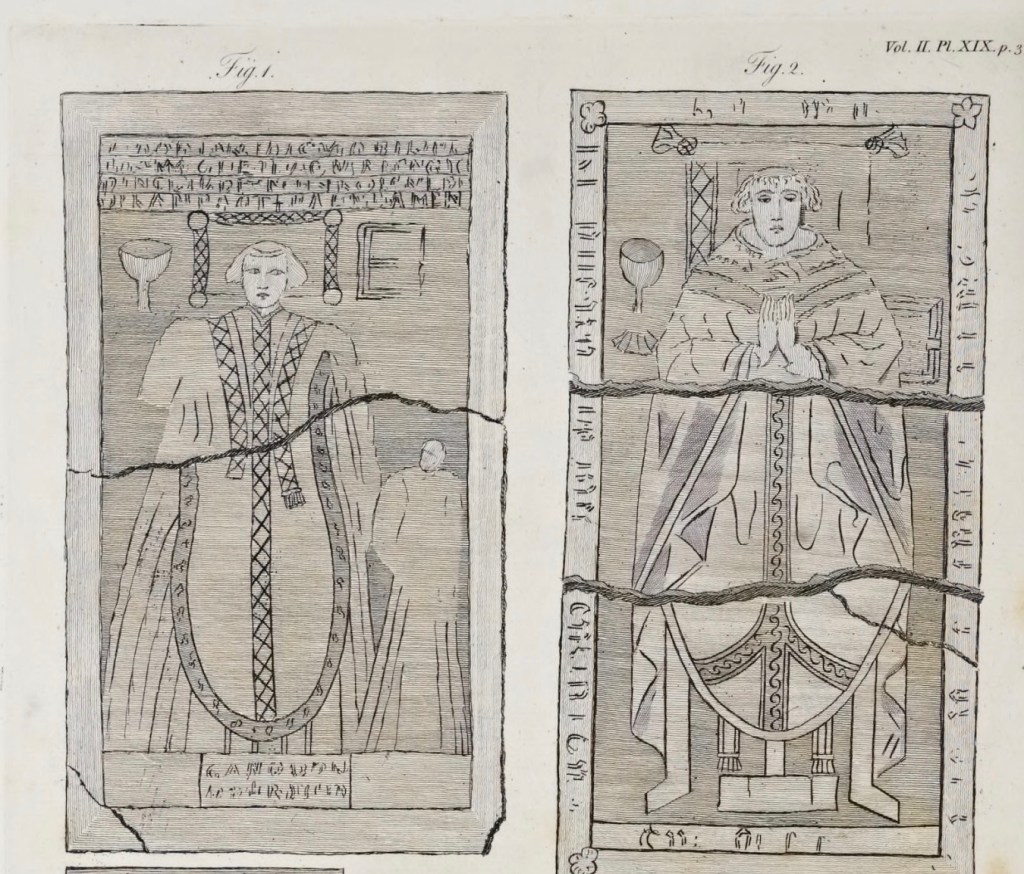
“ There fcratched upon the effigies of prieft in his veftments, his head lying on pillow or cushion, with a chalice in the corner on the right hand, and book in that on the left. The infcription in four linesabovethe pillow now all obliteratedexceptthe final word Amen and that at the feetin two lines totally gone.
The difficulty in determining who this perfon was not great, fince under the middlemoft of the threelights or pannels of the Eaft window, which in manner diredtly over the ftone, written in the black letter, (an inscription), whence one may fairly conclude, that as Roger Crycbe was Redtor of Whittington till A. D. 14.14 he was the perfon at whofe charge the window was made ………..
And then, 2dly, as obferved that the redtors of churches were ufually interred in their refpedtive chancels one can hardly doubt that the figure on the grave-ftone was intended for the faid Roger Crycbe. Cricb was good family formerly in Derbyffiire, named from the village and at this day in being .
The greateftAngularity in this graveftone the portraiture of little boy on the Redtor’s left fide towards the bottom. This certainly very remarkable, fince, after infpedting all the portraits on the monuments in my books, find nothing like it. We muft have recourfe therefore here to conjedture viz. that as the redtor of church in the 15th century could have no legitimate child, the nolettus or campanarius e. the youth that rang the facring bell muft thereforebe intended by this fmall figure. Perhaps he might die at the fame time as his matter Cryche, and be interred in the fame grave with him.
“ The dateof this ftone, you obferve, Sir, is in part afcertainedabove,and what was there allegedreceivesno fmall confirmation from the following grave- ftone in the chancel of the neighbouring church of Chesterfield fig. 2. This is alfo of alabatter,fix feet long, two feet eight inches broad, and has a like facerdotal figure fcratched upon with chalice and book, but the infeription goes round the edge,
“ Now, one may eafily fuppofe, comparing this ftone with the former, that the date here was “ millo ccccxi.” and that our ftone at Whittington of mccccxiv. but three years later was copied from it; this kind of monument, for ecclefialticsat leaft, being peculiar, as were, to this age. And have no doubt but the infeription at the head of the ftone at Whittington ending with the word Amen as above mentioned,confifted of much the lame matter, mutatis mutandis as this at Chefterfield. And thus the two graveftones finely illuftrate one another.
I am dear Sir, your affectionate and moft obedient fervant,
“ Sam.Pegge.”
His published works listed include
The Forme of Curry
The Forme of Curry was the title given to a book of recipes translated from Latin by Rev. Samuel Pegge. It is thought The Forme of Curry means the art of cookery or ways of curing or preparing.
The origins of the recipes are said to come from the master cooks in the Court of King Richard ll around 1390. The recipes were written, in Latin, on vellum. It is thought there was originally around 205 recipes and they were compiled by stitching pieces of vellum together as they came to the end of a piece another was added thus making a scroll.
One of his acquaintances was Gustavus Brander, Director of the Bank of England and a Trustee of the British Museum. Gustavusasked Samuel if he could do a portrait him however Samuel considered that there was one plate of him and saw no reason for another. Not to be put off Gustavus let it be known he had anoriginal manuscript of the recipes which he offered to Samuel on the promise he would let him carry out the portrait.
Samuel then set about translating the scroll to ‘middle’ English. He presented the finished book as follows;
THE FORME OF CURY,
A ROLL OF ANCIENT ENGLISH COOKERY.
Compiled, about A.D. 1390, by the
Master-Cooks of King RICHARD II,
Presented afterwards to Queen ELIZABETH,
by EDWARD Lord STAFFORD,
And now in the Possession of GUSTAVUS BRANDER, Esq.
A MANUSCRIPT of the EDITOR, of the same Age and
Subject, with other congruous Matters, are subjoined.
“-ingeniosa gula est.” MARTIAL.
TO GUSTAVUS BRANDER, Esq. F.R.S. F.S.A. and Cur. Brit. Mus.
The Forme of Cury is the first known English cookery book to mention some ingredients such as cloves, olive oil, mace and gourds. Many recipes contain what were then rare and valuable spices, such as nutmeg, ginger, pepper, cinnamon and cardamom.
As well as enhancing flavour a number of spices were used to add colour to the dishes, as Samuel put it, “gratifying the sight”. There is a particular emphasis on yellows, reds and greens, but gilding and silvering were also used in several of the recipes. Yellow was achieved with saffron or egg yolk, red with “sanders” (sandalwood) and green often with minced parsley.
There are recipes for preparing many types of animal meat, including some which may seem strange to us including whale, crane, curlew, heron, seal and porpoise.
There are about ten vegetable recipes, including one for a vinaigrette salad, which indicates influence from Portugal and Spain, as French cooks rarely used vegetables at that time. There are also several pasta dishes, evidence of Italian influence.
Some examples;
Pykes in brasey
Take pykes and undo hem on ye wombes and waisshe hem clene and lay hem on a roost Irne penne take Gödel wyne and powdour gynger and sugur good wone and salt, and boile it in an erthen panne and messe forth be pyke and lay the sewe onoward
Pykes in Brasey – Pike in sweet wine
Take pike and open them on the belly, and wash them clean and lay them on a roasting grid. Then take good wine and powdered ginger & sugar, a good deal, & salt, and boil it in an earthenware pan & dish forth the pike & lay the sauce on.
Payn ragoun
Take hony suger and clarifie it togydre and boile it with easy Frye, and kepe it wel fro brennyng and whan it hath yboiled a while; take a drope perof wip by fyngur and do it in a litel water and loke if it bong togydre. And take it fro the fyre and do perto the thriddendele an powdour gyngener and stere it togyder till it bigynne to thick and cast it on a wete table. Lesh it and serue it forth with fryed mete on flessh or on fysshe dayes.
Payn Ragoun – Candy Strips (Ragoun = Highly Flavoured)
Take honey sugar and clarify them together, boiling over a gentle fire, taking care not to burn it. And when it has boiled a while, take a drop by your finger and drop it in a little water and see if it sticks together. Then take it from the heat and while it is thickening stir in powdered ginger. As it becomes thick throw it onto a wet table and make it into strips and serve it forth with fried meat on flesh days or fish days.
Chyches
Take chyches and wry hem in ashes all nygt, open lay hem in hoot aymers, at morrow, waisshe hem in clene water and do hem ouer the fire with clene water. Seep hem up and do perto oyle, garlic, hole safroun, powdour fort and salt, seep and messe it forth.
Chyches
Take chick-peas and dry them in the fire-ashes all night, or lay them in hot embers. At the morrow, wash them in clean water and cook them over the fire with clean water. Boil them up with oil, garlic, whole saffron, hot spice powders and salt, boil it and dish it up.
There are a number of other books and articles available to read on the Internet Archive including one on ‘Derbicisms’
The British Library also have a copy of ‘A Narrative of what passed at the Revolution House’
and
- A Series of Dissertations on some elegant and valuable Anglo-Saxon Remains (chiefly coins), London, 1756.
- Memoirs of the Life of Roger de Weseham – Bishop of Coventry and Lichfield, London, 1761.
- An Essay on the Coins of Cunobelin, London, 1766. Evans (Coins of the Ancient Britons, p. 7 t cf. p. 342) approved of Pegge’s division of the coins, but not of the descriptions of the types.
- An Assemblage of Coins fabricated by authority of the Archbishops of Canterbury, London, 1772.
- FitzStephen‘s Description of London (translated from the Latin), 1772.
- Evelyn’s Fumifugium, edited by S. P., 1772.
- Forme of Cury : a Roll of ancient English Cookery, London, 1780; published from a manuscript belonging to Gustavus Brander.
- Annales Elise de Trickingham, &c., ed. by S. P., 1789.
- The Life of Robert Grosseteste Bishop of Lincoln, London, 1793, (Pegge’s principal work).
- An Historical Account of Beauchief Abbey (Derbyshire), ed. by J. Nichols, London, 1801, the printing of which was largely supervised by Pegge’s son Samuel.
- Anonymiana, or Ten Centuries of Observations, 1809; also 1818.
- An Alphabet of Kenticisms, printed in “Cleveland Words” &c. (English Dialect Society), 1876. (Nos. 10-12 were posthumous.) [3]
- A Disquisition on the Lows or Barrows in the Peak of Derbyshire, Particularly that capital of British Monuments called ArbelowsArchaeologia 7: 131-148 1785
- Illustrations of some Druidical remains from the Peak of Derbyshire drawn by Hayman Rooke Archaeologia 7: 19-24 1785
- Observations by the Rev. M Pegge on the Stanton Moor Urns and Drudical Temple Archaeologia 8: 58-61 1787
- Observations on an ancient font at Burnham Deepdale, in Norfolk Society of Antiquaries Nov 18 1790.
The following 2 books are available on the Project Gutenberg website. Just click on the titles.The Forme of Curry Anecdotes of Old Times
 Whittington-History