Whilst carrying out research into families with relatives in our churchyard I came across Francis Davenport and his family. They are not to be found in our churchyard but their story is worth telling. (NB this is not meant to be a scholarly article!)
Francis was born probably in Lancashire but later moved to Whittington. He married Alice Quicksall in Ault Hucknall in August 1671, Sadly Alice died in 1678. The same year, he married Sarah Browne. Francis and Sarah were practising Quakers. They were married in the Friends Meeting House in Leicester. At the time, being a non conformist was a serious matter. Non conformists did not accept the requirement to attend Church of England services.
Given Francis’s story, it is perhaps worth looking briefly at how we came to this point. Whittington was going to play a role in the future of the Country’s relationship with the Church of England.
We must revisit Henry VIII. He made efforts to annul his first marriage to Catherine of Aragon. Pope Clement VII refused the request. This refusal led Henry to initiate the English Reformation. He separated the Church of England from papal authority. In 1534, Henry appointed himself the Supreme Head of the Church of England. He dissolved convents and monasteries. These actions led to him being excommunicated by the Pope. Henry called on his Archbishop of Canterbury, Thomas Cranmer to drive forward the reformation.
Cranmer set out to move away from the traditions of Roman Catholicism. He aimed to include the saying of mass in Latin. He also wanted to develop a set of Anglican rules and order of services in English. Cranmer carried on his work following the death of Henry VIII and during the reign of Edward VI. This led to the 1549 Book of Common Prayer.
On the death of Edward VI the Catholic Mary I took the throne in 1553. She had Cranmer firstly imprisoned and then killed for treason and heresy. She reached an agreement with the Pope to bring Catholicism back to England. However on her death in 1558 her half sister Elizabeth I ascended to the throne. Elizabeth worked to re-establish the Church of England as separate from the Roman Catholic Church. At a meeting of senior clerics in 1563 the Thirty-nine Articles of Religion were agreed.
Elizabeth was followed by James VI of Scotland and James I of England in 1603. Attempts to persuade James to revert to the oversight of the Pope were ignored. This led to an attempt by Guy Fawkes to blow up Parliament in 1605. This only strengthened James’s resolve. In 1604, a conference was held to discuss the variance of the preaching of the Bible. As a result, a new translation and compilation of approved books of the Bible was commissioned. This aimed to resolve discrepancies among different translations then being used. The Authorised King James Version, as it came to be known, was completed in 1611. It is still in widespread use.
James was succeeded by Charles I in 1625 when reformation of the church was again in debate. In 1633, together with the Archbishop of Canterbury, they initiated reforms to promote religious uniformity. They restricted non-conformist preachers. They insisted the liturgy be celebrated as prescribed by the Book of Common Prayer.
Following the execution of Charles I his son Charles II took over the Crown in 1660. One of his first acts was to implement four penal laws collectively known as Clarendon Code are named after Charles II’s chief minister Edward Hyde, 1st Earl of Clarendon,
These included:
- the Corporation Act (1661) required all municipal officials to take Anglican communion. They were also required to formally reject the Solemn League and Covenant of 1643. The effect of this act was to exclude nonconformists from public office. Although the legislation was not rescinded until 1828, the legal power to enforce it lapsed in 1663. As a result, many evicted officials were able to regain their positions after a few years.
- the Act of Uniformity (1662) made use of the revised Book of Common Prayer compulsory in religious service. Over two thousand clergy refused to comply and so were forced to resign their livings (the Great Ejection). The provisions of the act were modified by the Act of Uniformity Amendment Act, of 1872.
- the Conventicle Act (1664) forbade conventicles. These were meetings for unauthorized worship of more than five people who were not members of the same household. The purpose was to prevent dissenting religious groups from meeting.
- the Five Mile Act (1665) forbade nonconformist ministers from coming within five miles of incorporated towns. It also forbade them from coming near the place of their former livings. They were also forbidden to teach in schools. Most of the Act’s effects were repealed by 1689, but it was not formally abolished until 1812.
The 1662 Book of Common Prayer was the authorised liturgical book of the Church of England. It was used by other Anglican bodies around the world. In continuous print and regular use for over 360 years, the 1662 prayer book is the basis for numerous other editions of the Book of Common Prayer and other liturgical texts.
The arguments and lobbying were vehemently pursued by the non conformists, but Charles would have none of it. His relationship with Roman Catholics in the end was unclear. His brother James, who was to succeed him, was a practising Catholic. It is believed that he was converted to Catholicism on his deathbed. Whether he was aware of the fact isn’t known.
This was the political environment that Francis and the Society of Friends or Quakers found themselves in. Quakers had no clergy, no pulpit, no ceremony, nor did they worship in a church. Quakers met in someone’s home or a simple meetinghouse. This was as far away from the requirements of the Book of Common Prayer as you could get.
Quakers were severely persecuted they could be fined, jailed, whipped even be subject to ‘tongue boring’. On 17th February 1677 Francis was holding a Quaker meeting in his home in Whittington when it was raided by officers of the Government. Francis and those attending the meeting were fined
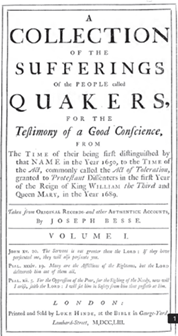
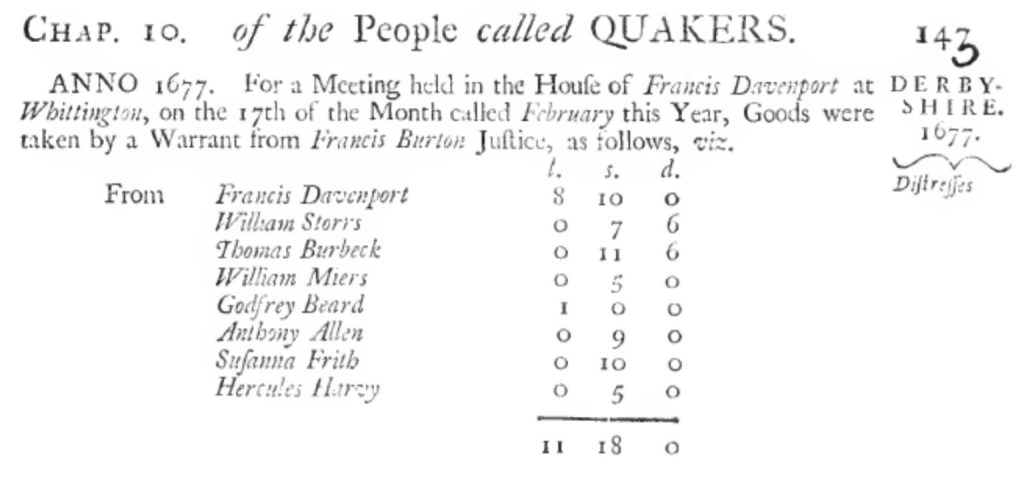
Also in 1677 the Bishops wanted an understanding of the numbers of those refusing to follow the requirements of the Book of Common Prayer. As part of the Visitation process, a Bishop or their representative visited the parishes. They checked on clergy and their work in the parish. Information was sought as to known conformists, papists, and non-conformists.
Some results from the Archdeaconry of Derby
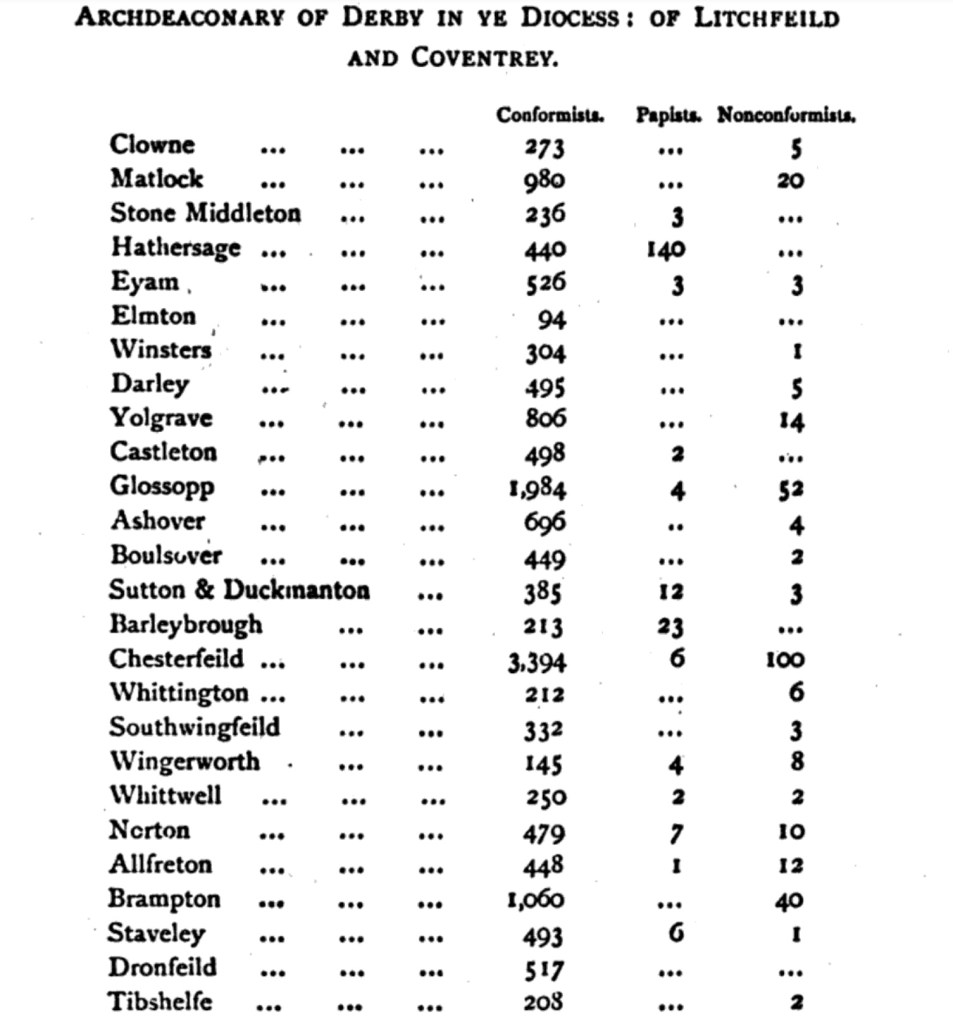
In 1682, the Court of assizes made an order. Every known person who refused to attend the Sunday Church of England service was to be fined 12 pence each time they failed to attend. From this list we can see that Francis was listed as one of those subject to a fine
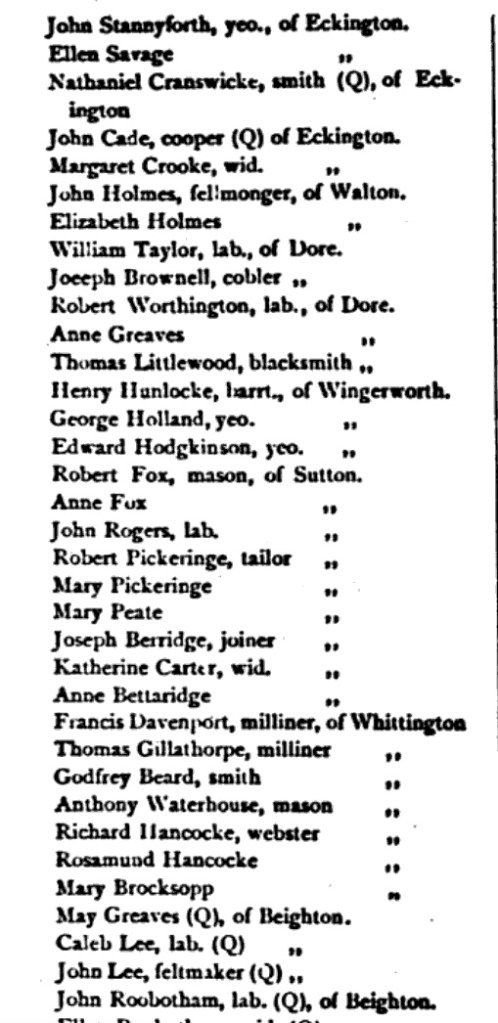
These 2 listings are from Rev.J Charles Cox book Three Centuries of Derbyshire Annals – Records of the Quarter Sessions of the County of Derby
Probably as a result of these pressures Francis decided to emigrate with his family to America. According to the History of Burlington and Mercer Counties, New Jersey. 1883
‘Francis Davenport, of Whittington, in Derbyshire, England, came to Burlington in 1683, with his wife, Sarah, and three daughters born at Whittington, Sarah, Anne, and Bridget. He located on a tract of seventy-seven acres of land on Crosswicks Creek, about three-quarters of a mile east of the village of Crosswicks. On it he built his cabin, not far from the third ford of the creek. Here he opened a store, receiving his goods by water from Burlington. We find in Revell’s “Book of Surveys,” page 90, 1st mo. 1691, “Surveyed there for Francis Davenport one parcell of land adjoining to his former settlement, containing seventy-seven acres, the two tracts contayning together 677 acres besides allowance for Highways at five acres per hundred.”
The village where Francis and his family settled was believed to be Recklesstown which had been named in honour of one of its founders, Joseph Reckless. However a local congressman (believed to be Francis) considered the name to be subject to ridicule and so on 6th November 1888 the community’s name was changed to Chesterfield, named, it was said, after the 2nd Earl of Chesterfield whose seat of Chesterfield was in Derbyshire, where many of the township’s earliest settlers had lived. The township was reformed by Royal charter on January 10, 1713, and was incorporated as one of New Jersey’s initial 104 townships by the Township Act of 1798‘

I am unable to trace the source but it was reported ‘FRANCIS DAVENPORT, however, was the original of the famous “Pooh Bah” of Gilbert and Sullivan’s opera, holding at one and the same time the offices of high sheriff of Burlington County, justice of the peace of Somerset, Essex, Bergen, Gloucester, Burlington, Salem, Cape May, Monmouth and Middlesex Counties. He was also an assemblyman at various times, and a judge of the higher courts, thus serving continuously in several important offices until his death.’
Francis’s occupation was listed as milliner.
As well as the 3 daughters that emigrated to America with Francis and Sarah they had another 7 children 2 of which sadly died in infancy. Sarah died in 1691.
Francis later married Rebecca (Whitton) Decow, widow, of Isaac Decow, of New Castle County, Pennsylvania in 1692.
Francis and Rebecca had 2 children Isaac and Rebecca.Francis died on 1st February 1707 in Burlington, New Jersey.
We do have a booklet that goes into a more detail for anyone interested. (Price £2.50)
We have also produced a podcast about Francis’s story.
 Whittington-History