This article is from a booklet written by Trevor Nurse in 2007.
The Beginning.
No records exist of when the racecourse was first used. It was probably a gradual use by local gentlemen. They used the moor to race their horses. The moor was common land and therefore an ideal place being relatively flat, and not far out of town. It obviously grew in popularity and gradually became well attended by the noblemen and gentlemen of the area.
The first permanent racecourse in the country was recorded at Chester in 1540. In 1660, Newmarket was designated the headquarters of British horse racing. A horse race in Chesterfield was mentioned by a parish clerk in Ashover. He wrote about a race at Chesterfield in July of 1692. This race was almost certain to have been on the Chesterfield racecourse. In those days, racing was a sport for the very rich and wealthy. This group included the noblemen and gentlemen of the country. I suppose it is much the same today. I, like many of the general public only get involved in the betting side of the sport. These wealthy owners would take their horses around the district. This gave them a few days out in towns like Nottingham, Derby, and Lincoln. They also visited Chesterfield, which apparently was one of the oldest venues. At that time one of their grooms would walk and trot the horses from venue to venue.
The date of 1692 is only four years after June 1688. This is when the plotting at the Revolution House took place at Whittington. To me, this is interesting. The Earl of Devonshire met three other noblemen in June of that year. They gathered on Whittington Moor. They were in the guise of a hunting party. Their purpose was to plot the overthrow of the king and bring William of Orange to the throne. The story tells of a shower of rain. It made them seek shelter in the Cock and Pynot Inn at Old Whittington. It was here that the plotting took place. Thinking about this, why would the Earl of Devonshire meet these Noblemen on the moor? He owned much better hunting areas than this small piece of common land. Even then this moor was only minute; a man on horseback could cross it in less than 10 minutes. Also, there wouldn’t be much game there. You might find a few hares and rabbits. There is also a sprinkling of grouse and pheasants. Therefore, in my opinion, it is most probable that these noblemen met at this relatively new racecourse. It is not likely that they met while hunting as the history books suggest.
The Earl of Devonshire (William Cavendish) at that time was very much involved in Chesterfield. He owned quite a lot of property in the town. He was a frequent visitor. It is well known that his two main interests were horse racing and cock fighting.
Chesterfield’s Recorded Racecourse.
The first official record of the racecourse was in 1712. The Scarsdale Stakes was competed for during that time. By then, it was obviously a well-known meeting in the area. Around 1728 the meetings were in July over three days, with one race on each day. The first race was for £40 for six-year-old horses. The second race offered a 10 guinea purse for Galloway’s. The third race provided a 20 guinea purse for five-year-olds. Prominent racing men at that time included The Duke of Ancaster and Sir Charles Sedley. Sir Richard Grosvenor, Earl of Portmore, and Lord Hamilton were also notable figures. Much of the information from this early period comes from the race cards and programmes. The earliest one found so far is dated 1733 and is in the Chesterfield Library. It was found under the floorboards of a house in Sheffield. The house was once a coaching Inn. Thus, it was suggested that the programme may have been left there to advertise the races at Chesterfield. The card shows races taking place over a three-day period, the 18th, 19th, and 20th of July. Racing was at a low ebb during this period. There were only three horses entered for the plate on the 18th. The Duke of Ancasters Bay Mare “Music” was one of them. On the next two days there were only four horses entered each day. The programme was printed in Nottingham by a George Ayscough. In that same year, a Sheffield printer published a race card for the Doncaster races. It had the same heading picture that was displayed on the Chesterfield programme.
In 1735 Lord Scarsdale’s plate was the only race that filled, and for this there were only three runners. Racing was the same throughout the country. In the next two years, Chesterfield is said to have been the only meeting in the midlands. By 1740, things began to improve. It was noted that Lord Scarsdale’s plate was withheld that year. The race was taken over by a 50-guinea prize for five and six year olds. For this, there were nine starters. The Chesterfield Museum has three programmes around these dates being 1758, 1787 and 1788. In the meeting of 1758 Lord Byron’s name appears, this must have been the poet’s father. Also the names of Sir Charles Sedley and the Marquis of Rockingham entered horses that year.
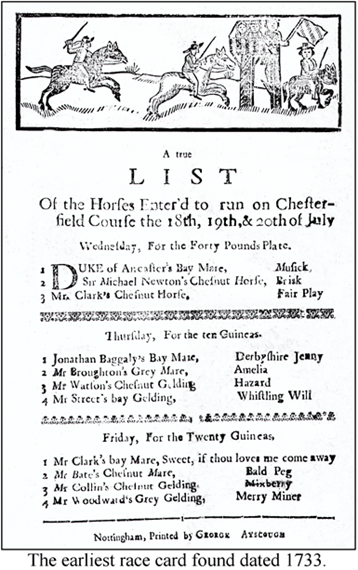
It was on this programme that the social activities of the races began to appear. The Gentlemen visitors and their ladies had to stay in hotels in the town over the three-day meetings. They also brought with them several servants and grooms. The Duke of Devonshire had a large party, at times using three coaches and about ten outriders on horseback. The Inns provided dinner and a ball after, also the theatre put on special plays and also concerts were arranged. The Noblemen favoured the Falcon, The Old Angel, and the Royal Oak at this time. The Royal Oak later changed its name to “The Castle.” These three Inns were in the same vicinity, only being a few yards apart, the Theatre also being nearby. Like all Inn’s at that time, they had large yards at the rear with stables which could accommodate a large number of horses.
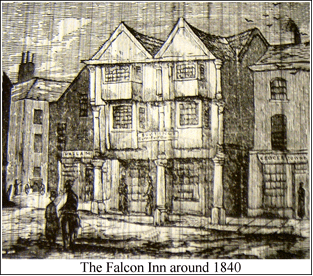
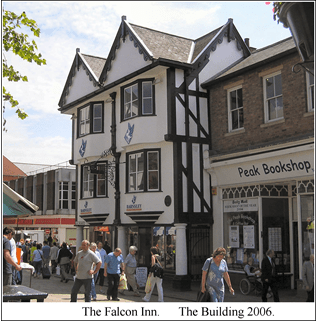
The Castle Inn was at the bottom of the market, where the entrance arches are today. It was next to Boots the chemist. The pub closed in 1910. The Old Angel was on the bottom side of Packers Row. It was a very old coaching Inn and closed in 1940. Cantors furniture shop was part of the building a few years ago. It had a large yard at the back, where a small car park is now. There was a large concert room above its stable block. The Falcon remains much the same today as it was all those years ago. Many shops now occupy the Falcon Yard at the back. The sketch shows it as it was in 1840
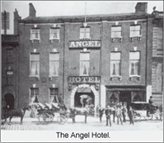
and the photo how it is today, as can be seen it has been restored to its original condition. I remember when Bodens had a fish and chip shop down the side. The Angel Inn, which later was known as the Angel Hotel was on the High Street. It was pulled down in 1926. A new bank was built on the site. This construction also left room for an extension onto the Post Office. In its hay-day, it was a very large Coaching and Posting Inn. The inn had stables at the back. These stables catered for over one hundred horses at one time. This was favoured by the Noblemen a few years later than the other three
The original racecourse was long and narrow. It was mainly on the lower side of the moor where the ground was flatter. This area was said to be a little waterlogged at times. In 1774 Sir Henry Harpur promised to give 100 guineas towards drainage to make the course dry. The 1787 programme had more information. Racing was in September and didn’t start till 4 o’clock. This schedule obviously gave time for some of the entrants to travel the same day. It also appears that the course was plagued by stray dogs; the programme suggests that if any of the public saw dogs on the course, they were at liberty to destroy them, (Strong words.) In that year the lunches and dinners were arranged at the Castle Inn, the landlord then being Mr. Bluett. Plays were being performed each evening at the New Theatre after the races had finished. Entrants to the races that year included the Duke of Rutland.
In June 1788, the centenary celebrations of the plotting of the Revolution took place. Therefore, we could say that racing on the moor was virtually 100 years old. The race programme had a different picture heading. Meals and the evening dinners were held at the Falcon Inn. The next year meals were at the Old Angel Inn and the Cocking at The Castle Inn. Cocking was the word used for the cock fighting venues, which was specially arranged for the race day evenings. Some of the bouts were between Derby and Nottingham. This barbaric sport was widely accepted by the noblemen of the area. The race cards indicated that it took place in the yards and stables of the Inns.
Some of the racehorses entered for that year were from Lord Stafford. Others were from Lord Belfast, Sir Charles Turner, and Sir John Ramsden. In 1797, the course underwent a large alteration. The width was nearly doubled, and some sharp corners were removed. This was done just before the races of that year. The course must have included the slope where Stand Road is now. This change would have lengthened the course, making it nearly two miles long. It’s hard to imagine the course at this point in time. There were no buildings around it. If anybody stood at the top of the rise where now is Avenue Road, they would likely see about two thirds of the course. This vantage point would allow them to follow the horses nearly all the way round. Most of the people at the races would be of the higher class, being owners, trainers and visitors from around the district. Nobody at that time lived on the moor, although there would have been a couple of farms nearby. There may have been a race stand built at this point. If so, I assume it was just a raised platform on steps with a rail round. Naturally, the first stand would be made of wood.
1800. The next seventy seven years.
By the turn of the century the races became more popular and its status improved nationally. The old picture logo finished in 1802, the new one appeared as seen below. In 1805 the Duke of Devonshire continued to subscribe £50 to the races. The Angel
Inn was the venue for meals and the evening dinner.
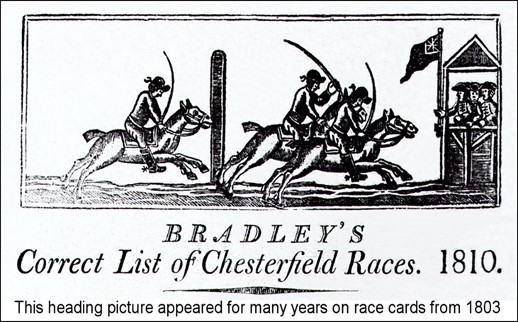
It was stated that the trumpet used for calling for the saddling of the horses was to be discontinued. A bell was to be rung instead for the start. Also, constables were to attend to clear people back behind the cords of the course.
The Whittington Award, (Enclosure Act.) was in 1821. This basically gave the common land in the parish to the Lord of The Manor. Half of the racecourse was in Whittington and therefore given to Henry Dixon with certain stipulations. These mainly being that the racecourse and races were to go on as usual. No buildings should be built on or around it. Henry Dixon should maintain the fences and turf around it. Also that no pits should be dug on or around the course and no temporary roads made across it. It is obvious when this was drawn up that concern was for the number of pits being dug for the extraction of coal around the village at that time
The Newbold Award wasn’t until 1837. This awarded the other half of the racecourse, including the stand and judges stand, to William Spencer Duke of Devonshire. The races were very popular during the first half of the 1800. In 1829, there was a proposal to build a new race stand.
The Great Stand.
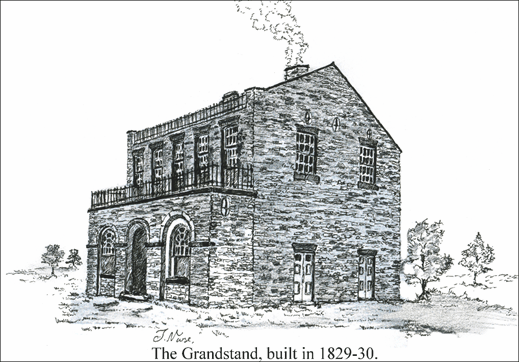
In that year the sum of 197 pounds had been collected for that purpose. The Duke of Devonshire subscribed £50 toward it. The whole amount had not been collected. However, the building started at the end of 1829. It opened in 1830. It was designed on the lines of the Doncaster stand which was built a few years before.
Before this, there was another stand of sorts. It was most probably constructed of wood. This wooden stand may not have been in the same position as this new stone one. By 1842, there was £200 still owing on the new stand’s construction. The debt needed to be paid off. Therefore, subscribers were called for. If any subscriber paid more than £5 towards the stand, they received a Silver Ticket. This Silver Ticket enabled them to enter the stand free of charge. The normal fee then was three shillings and sixpence per day.
These tickets were like coins about the size of ten pence piece and were die cast. On one side it said Chesterfield Racecourse. Built 1830. On the other side it said Admission Ticket with its number, the one shown is number 44. I don’t know how many of these were issued. It is interesting to note that three of these silver tickets were produced for the stand on the last meeting in 1924.
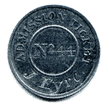

Front and back of a Silver Ticket.
From pictures of the stand, it appears that the front part was built separately. We can see a definite break between this and the main building. Therefore, this could have been built at a later date. This part may have been an extension to include the weighing rooms. They apparently used to be a temporary structure put up on the other side of the course. The top tier of the stand was sometimes plagued with smoke from the two chimneys. These chimneys were obviously not high enough. In 1863 one of the chimneys caught fire and dense smoke swirled round the heads of the occupants. There were many suggestions over the years to cover the stand against the bad weather. However, nothing was ever done about it. There must have been a concern about its stability at some time. This was particularly true when full of spectators. In the picture, we can see strengthening metal tie rods running through to stop the end walls bellying out. There was a stairway of stone steps to get up to the top. These steps became very slippery when wet. This stairway must have been on the bottom side and out of view in the picture shown.
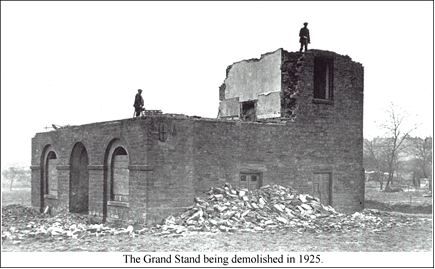
The Telegraph Company fitted its wires to the stand in 1864. This allowed results to be sent to all parts of the country immediately. It happened as soon as each race was run. The caretaker of the stand lived in the rooms on the ground floor. The stand was only used for a few days each year. I think the caretaker lived there with virtually little rent to pay. The caretaker probably looked after the stand without pay. My great grandmother was the caretaker in 1901. I know that Joe Davis’s grandfather was the caretaker in the 1920’s. (Probably the last one.)
The stand was demolished in 1925, although another report gives this date as 1928.
The Judges Stand.
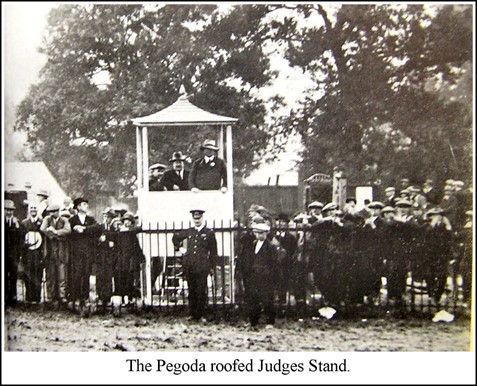
In 1853 saw the erection of a new Judges stand, which was built in a better position than its predecessor. It had an unusual roof, very often referred to as a Pagoda. It appears to be made of wood.
This photo of the judges stand was taken in the 1920’s, and therefore may not have been the original one built in 1853
The Early Course.
In 1797 it is said the course was virtually doubled in breadth. The sharp turns were removed with a large circular bend at the top. To do this, the horses had to race up an incline to the winning post near the top of Stand Road. This was interesting. Fast horses around the course sometimes failed here. In contrast, the stronger horses would come through to a good finish. Many improvements were made to the course in 1852. Posts and rails were erected for quite a distance above and below the Grandstand. The whole course had posts put round it with ropes in between. This was done to stop spectators from coming onto the course to see the horses coming round the bends. In 1837 one race had to be stopped because some horses had to be pulled up because of people running onto the course.
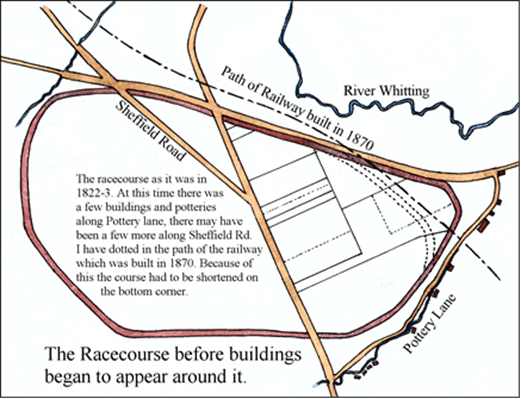
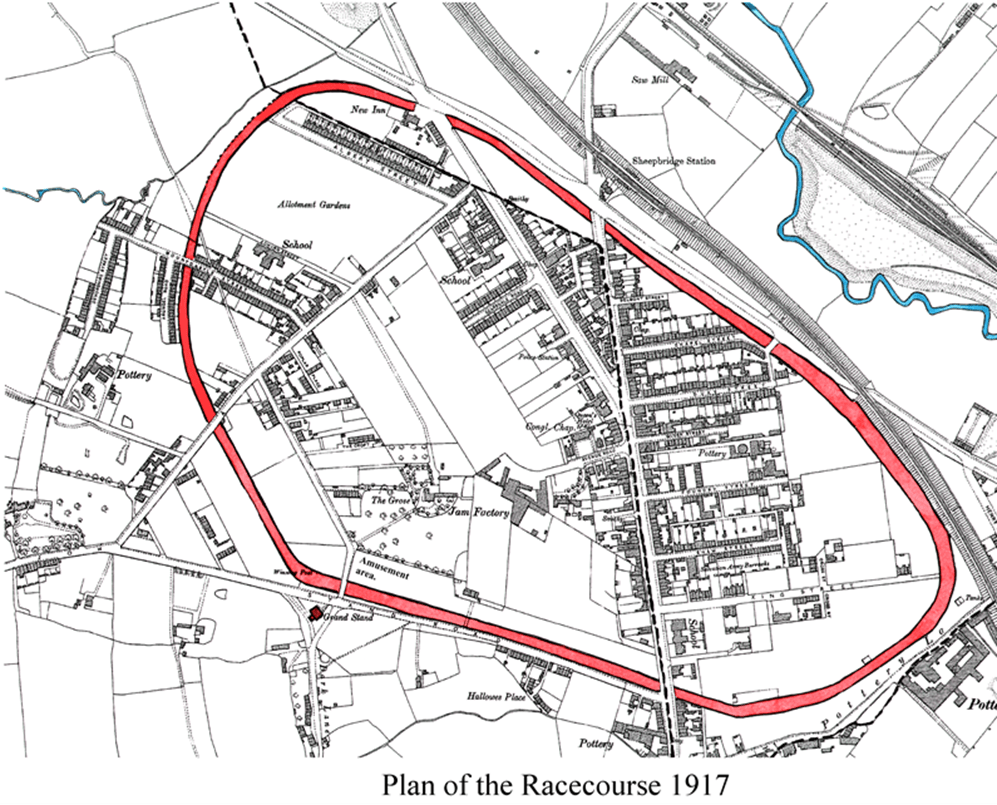
Up to about 1840 the racecourse was free of any buildings around it, apart from the stand itself. Therefore, spectators could see the horses run around most of the course. They had central positions on it. The map shows it as it was around 1825.The Good years of the Racecourse.
At this time the Chesterfield races were popular to people of all classes and were very well attended. So much so that concern was raised by the vicar of Chesterfield that it brought in people of disrepute. This is always the case when you have large crowds of people. However, he stopped the old tradition of ringing the church bells on race days, so that the church was disassociated from the racing.
This upset many prominent people in the town as it was part of the race scene since racing began. Horses were paraded through the town. They were ridden down to the racecourse at the sound of the church bells ringing. People would line the route down to Whittington Moor. Several letters were sent to the vicar to reconsider, but without success.
In 1842 The Duke of Devonshire withdrew his support for the races. It was said the races encouraged tricksters, conmen, pickpockets, and gamblers. This was probably for the same reasons. However, in 1844 after having discussions with the organisers he did continue his support.
The Earl of Chesterfield was another nobleman who entered races at the racecourse. His seat was at Bretby near Burton on Trent, his father’s seat was at Elveston Castle just east of Derby. The name of Lord Chesterfield was closely associated with the races in the 1840s. His popularity was so overwhelming. People used to say that if his lordship’s colours were in any race, the starter would wait. They would not drop the flag unless Lord Chesterfield’s horse was sure to get the best start. The judge always hoisted Lord Chesterfield’s number if his horse were among the first three or four. No doubt common report exaggerated the matter. However, it was certain that the Earl ceased to enter horses at the Chesterfield meeting. He confided to a friend that they were unduly favoured.
It must have been quite an experience. People witnessed all the noblemen arrive at the races in the first half of the 1800s. It was noted that the Duke of Devonshire came to Chesterfield for the races in 1829. He arrived in his state carriage. Six horses pulled it. Also with him were two coaches with four, and several outriders. Mr. Rodes of Barlborough Hall always had a train of coaches when he visited the racecourse. At that time, their racehorses were walked from course to course. They needed time to rest before the races. We have to imagine Whittington Moor with no buildings around the racecourse. Only the road went through to Old Whittington and then on to Dronfield. The organisers were mainly noblemen. A good half of the enthusiastic spectators were from the higher class of gentlemen in the surrounding areas. These as previously described would stay in Chesterfield and then drive down to the course on race days. Many spectators would walk to the course from the surrounding villages. When the stand was built, a road led from Sheffield road (Stand Road) up to it. All the carriages and other transportation vehicles parked just below it, where the top of the park is today.
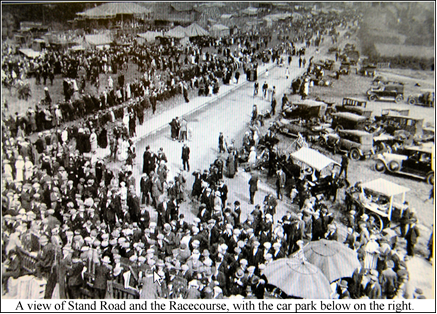
This photo was taken from the Grandstand and shows quite clearly the Gentlemen’s car park. It must have been taken some time in the 1920’s.
As described earlier the Duke of Devonshire would give a high-class dinner for all the Noblemen attending the races. These dinners took place over many years until 1842. This was when he withdrew his support for the races. However, for a number of years after this, he supplied venison for these special meals. I must add he did renew his support in 1845. No record of these Lavish Dinners appeared after about 1860, but probably resumed, but not in such a grand event. The end of the dinners was when the racecourse lost its first-class racing status in 1877.
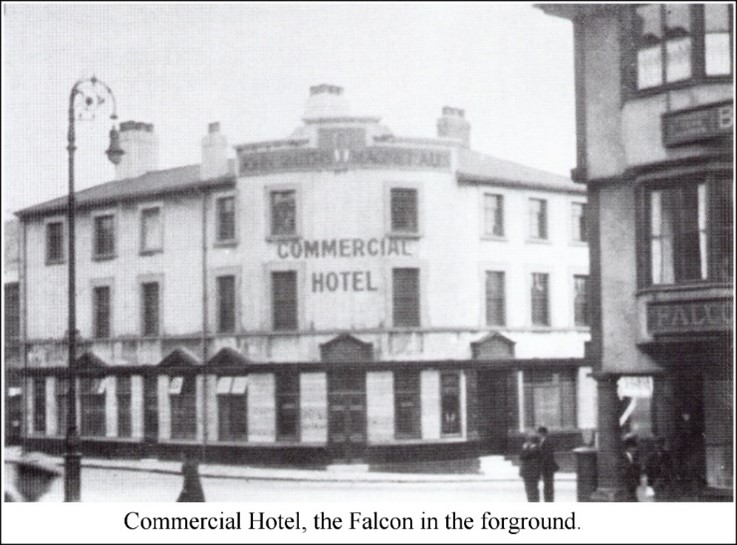
Below is the menu for the Dinner in 1856. This event was at the Commercial Hotel. The Gentlemen then preferred this venue over the Angel Inn.
Menu. Commercial Hotel 1856.
First course.
Turbot and Lobster Sauce Soles, Soups Turkey, Fowls, Ham
Tongues Calves head Ash Goose
Pigeon and Veal Pies Roast Beef Haunches of Venison
Second Course.
Grouse Partridges Hares Plum Puddings
Balewell Puddings Damson Tarts Apple Tarts Lemon Cheesecake
Jellies Custards Blancmange
Deserts.
Grapes Peaches Filberts Apples
Pears Walnuts Magnuni Bonum Plumbs
Almonds Raisins Plumb Cakes Sponge cakes
The Innkeepers and Traders Booths.
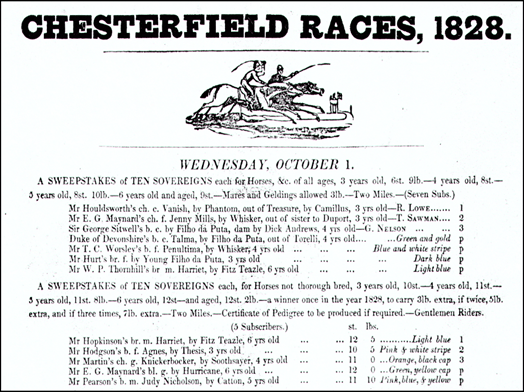
The trader’s booths were always well sort after. They were so popular that they were auctioned off at a meeting. This meeting was held at one of the public houses in the town, well before the race days. At that time, booth holders would advertise their locations on the race ground. They used the Derbyshire Times for this purpose. Innkeepers had upwards of 20 spacious booths erected. William Durham of the Crown at New Whittington use to go down to the races regularly to sell his beers. Below is the advert for the races of 1854.
Chesterfield Races. Derbyshire Times, 23rd of September 1854.
John Newton of the Bay Horse Chesterfield will be glad to meet his Sheffield and Chesterfield friends at the race stand where they will meet with every accommodation.
John. Dronfield of the Red Lion Inn Brimington will be happy to see his friends at Booth No. 2 at the head of the course. Genuine home brewed ales.
John Henson of the Anchor Inn Chesterfield respectfully informs his friends that he will be happy to afford their every accommodation at the upper portion of the race stand during the races. Foreign wines spirits and Chesterfield Ales.
Henry Conway of the Peacock Inn Chesterfield wishes to inform his friends that his Booth on the course is No. 3 where he will be glad to accommodate them with the choicest wines and spirits also the celebrated Brampton Ales.
Richard Clarke Turf Tavern Chesterfield begs to announce to his friends and customers that he has taken Booth No. 3 near the stand where they can depend upon receiving every attention. Ales, beer, porter, spirits etc of first rate quality.
Samuel Gregory of the Red Lion Inn Brampton announces to his friends he has taken Booth No. 8 on the racecourse opposite the stand where he will be happy to see them and where they will find, good accommodation and superior refreshments.
Mrs. Waterhouse of the Green Dragon Inn Chesterfield respectfully announces to her Staveley and Chesterfield friends she will have much pleasure in seeing them at. Booth No.11 on the racecourse where they will find refreshments of every kind and superior quality. Ales, beers, spirits of the best quality.
Mr. Henstock begs to announce to his friends and customers that he has taken the old and well accustomed Booth at the bottom of the lots where he will be happy to see his old friends where they may depend on getting goods of the first quality and every attention paid to their comfort and accommodation.
Below is the Race Card of that year.
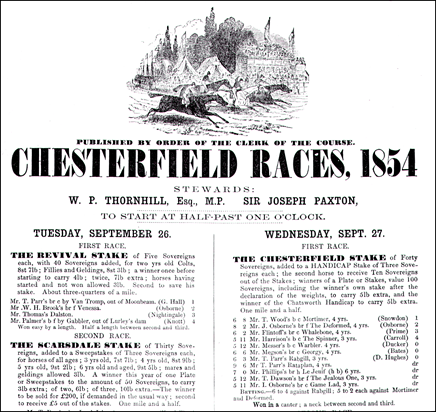
Joseph Paxton was one of the Stewards for that year. This is interesting because he was a good friend of the Duke of Devonshire. He was better known for designing The Chrystal Palace in London for the Great Exhibition of 1851. Also he designed the Chatsworth Gardens and greenhouses.
1st Class Racing at Chesterfield.
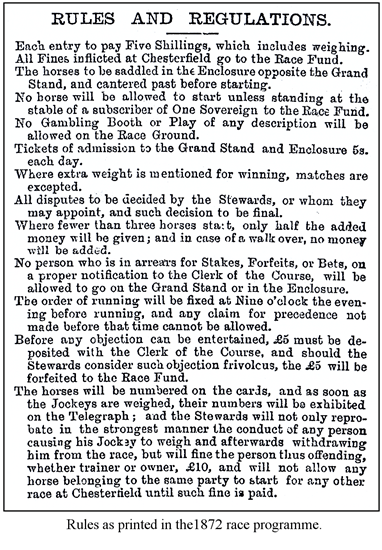
Up to 1877, Chesterfield was one of the best venues in the north. Horses and jockey’s alike came from far and wide to race here. Races were held under the jockey club rules, therefore being listed nationally. The racecourse rules as printed on a 1872 race-card can be seen below.
Some of the Jockeys are worth a mention, the most notable one being Fred Archer.
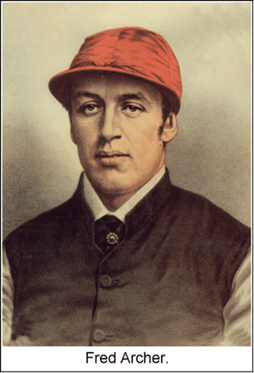
He was born at Pretbury near Cheltenham. His father was a jockey before him and was determined to make his son one too. He is the one jockey most memorable who rode at the racecourse, which was on the 28th of September 1870. This was his first race success on the flat and went on to be Champion jockey from 1874 to 1886. At Chesterfield, he won the Nursery handicap for two-year-olds. He was only thirteen at the time. He carried six stones five pounds. The horse he won on was Mr. Bradley’s Atholl Daisy, which was a three to one against winning the race. The owner for his gratitude sent a pound of green tea to Archer’s father. He also rode on the second day and came second on the same horse in the Hartington Plate. All this happened in the second year of his apprenticeship.
Fred came top of the winning Jockeys table for thirteen years. His total mounts were 8004 with 2748 wins. He won the Derby five times. Fred came top of the winning Jockeys table for thirteen years. His total mounts were 8004 with 2748 wins. He won the Derby five times. He also won the St. Ledger six times, Oaks four times, 2000 Guineas four times, Grand Prix de Paris three times, and French Derby twice. He was fairly tall for a jockey and as he grew was constantly concerned about his weight. He was constantly in Turkish baths and dieting to try and keep his weight down. On the 8th of November 1886, his doctors diagnosed him with typhoid fever. Two nurses were engaged to help his sister look after him. Physically he seemed to be getting better, but he was under a deep mental depression, thinking he was going to die. While in his bedroom he told his sister to send the nurses away, then getting a revolver out of a draw, put it to his head and shot himself. The genius which had flashed so briefly across the racecourses of England was extinguished. His wonderful career was over. After his death legends and stories were told about him, it is still said that his ghost haunts Newmarket heath riding there on a pale grey horse.
Across the heath, along the course.
Tis said that now on Phantom horse
The greatest horse jockey of our day
Rides nightly in the moonlight rays.
Other great Jockeys who rode at Chesterfield.
Sam Darling rode in 1832 winning the St. Ledger the following year.
John Osborn, was another famous jockey who won at Chesterfield in 1851.
Thomas Chaloner, an apprentice to J. Osborn came to Chesterfield in 1857 and won the Cavendish stakes, Scarsdale stakes, Innkeeper’s stakes and the Ladies stakes. He had many other successes winning the St. Ledger five times and the Derby
once.
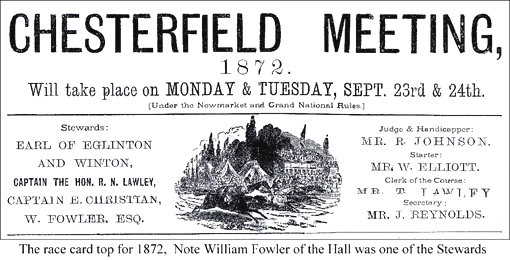
Below is the name of some of the most popular races which took place on the racecourse.
The following five races ceased when the first-class racing finished in 1877.
The Scarsdale Stakes. 1712 to 1877.
Chatsworth Stakes. 1855 to 1877.
Cavendish Stakes. 1855 to 1877.
Hartington Plate. 1859 to 1877.
Nursery Stakes. 1861 to 1877.
Note these races were associated with the Duke of Devonshire.
The following popular races took place over a period of over 50 years.
Sheffield Stakes. 1845 to 1914.
Ladies Stakes. 1846 to 1924.
Innkeepers Stakes. 1843 to 1924.
Stand Plate. 1865 to 1914.
The following five races were popular when all first-class racing had finished.
The race names must have been put forward by the new committee.
Tradesmen’s Plate. 1879 to 1919.
Consolation Scramble. 1880 to 1924.
Dunston Plate. 1882 to 1914
Newbold Stakes. 1882 to 1924.
Whittington Stakes. 1890 to 1924
The race card changed by 1886 to a small folded one, the front and back is shown here. Mr. Henry Jenkinson was the Clerk of the course and scales. He was the gentleman farmer who lived at the Holly House, Old Whittington.
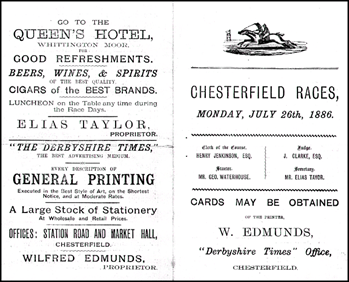
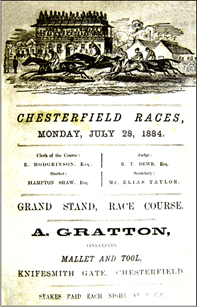
On this race card of 1884 we see Elias Taylor as the secretary; he was at that time the Landlord of the Queens Hotel.
Proctors Racecourse Amusements.
Racecourses have always attracted various amusements over the years, Chesterfield being no exception. The early amusements were of course cock fighting and boxing which brought the betting sharksters.
In 1842 the Derby Courier referred to these activities for that year as “The West End Amusements”. Reported there were Tumblers, Singers, Fortune Tellers, Aunt Sally’s and of course Boxing Booths.
In 1865 the type of entertainment got better. Reports describe Indian War Dances. There was also a Lion Tamer and Viftin, a weak-kneed giant. Also in that year was a Photographer’s Tent. Photography was invented about that time and therefore something of a new attraction.
The roundabouts began to get more sophisticated in the 1890’s. Prior to this, the old favourites were the Helter Skelter and the Swinging Boats.
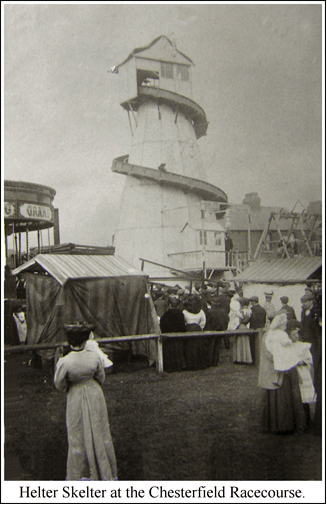
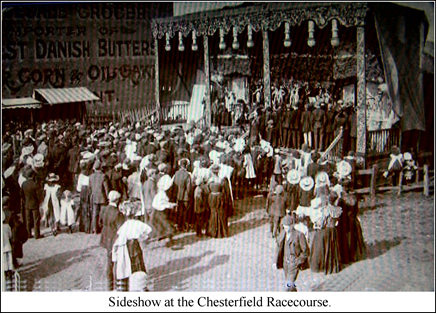
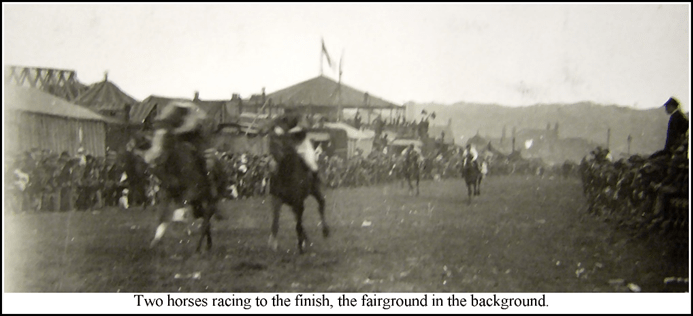
The picture above shows one of the side shows of which there were many around the early 1900’s, these being very popular, along with the old favourite Boxing Booths.
By about 1922, roundabouts began to be more cleverly designed, and in that year, there was reported to be an aeroplane flight. The aeroplanes whirled round on wires; I would think these types of rides being developed from the old flying chairs.
The reported crowds at the races over the years were.
1842.– 7000 1850.– 10000. 1852.– 50000
Interestingly on the last meeting in 1924 it was reported that there couldn’t have been more that 1000 present, but I must add that it rained the first day.
The Beginning of the End
It was in 1877 that certain rules were laid down by the Jockey Club and unfortunately the Chesterfield Racecourse committee couldn’t meet some of them. One of them being the amount of prize money needed. Therefore, in that year, it lost its first-class status as a racecourse. Because of this, many well-known jockeys and horses didn’t attend the course. The annual races became known as Flapping Meetings. Some of the higher-ranking noblemen with their horses abandoned the meetings. However, interested parties took it over. Racing continued despite these changes.
It is interesting that the committee then generally consisted of local businessmen. Previously, the Gentry used to have all the say.
It was in 1922 that the writing was on the wall. On the 25th of July of that year the Town Council met on the subject of the Racecourse. It was decided to place a bill before parliament to take away the right to hold horseracing on Whittington Moor. This then would leave
the way for much needed development there. Whittington councillors attending were, Sir Ernest Shentall, Fred Davis, Dennis Sims and W. E. Twelves. It is also interesting that also in 1922, over 50 horses entered the races, probably the most for over 40 years. (this of course doesn’t mean that they all ran.)
The following year the attendance wasn’t good, although the bad weather for that year didn’t help, and by then the Chesterfield Corporation had agreed to give the race committee the sum of £250 to vacate the course, the money was to cover any debts incurred.
The Last Meeting.
This took place on Monday the 28th of July 1924, and it was reported that it rained all day. The race committee tried to stage a Grande Finale. However, nobody seemed to be bothered. Even the jockeys dressed in ordinary attire, even though their colours had been registered. It was apparent that most of the people who came were for Mr. Proctor’s amusements and not the racing. Below is the race programme for the first day.
2.15 pm. Trial stake. First introduced in 1898.
3.00 pm. Innkeepers Plate. First introduced in 1842.
3.45 pm. Sheffield Stakes. First introduced in 1845.
4.30 pm. Whittington Selling Plate. First introduced in 1882.
5.15 pm. Ladies Stake. First introduced in 1846.
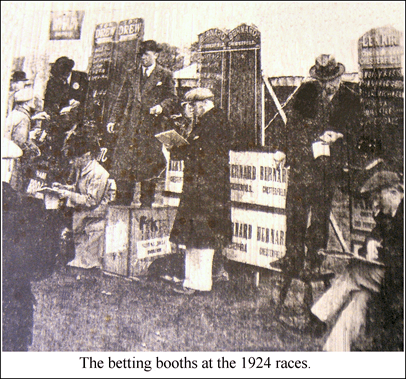
There was a shortage of jockeys at that last meeting. Therefore, anyone who could ride was considered. A local Whittington man named George Smith rode and won the last three races ever to take place on that historic racecourse. What a feat for him! His obituary was reported in the Derbyshire Times in April 1962. This obituary is reproduced below.
Chesterfield’s last winning Jockey.
Mr. G. Smith’s Place in Local History.
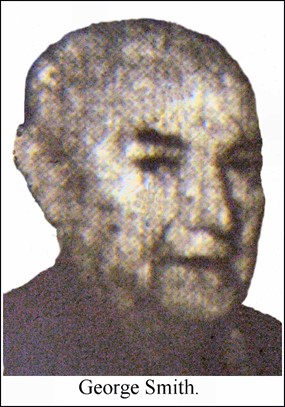
A link with the still-remembered Chesterfield race meetings at Whittington Moor was severed by the death on Saturday of Mr. George Smith aged 67 of 25 Shaw Street. The man who had the distinction of riding the last three winners at the final meeting on the old racecourse in 1924. A horseman for most of his life, George Smith trained animals for local owners including Mr. Fred Davis, father of Joe and Fred Davis, the billiards and snooker champions.
On July 29th 1924, the last race meeting was in progress on the Moor. There was a serious shortage of jockeys. As a result, George Smith rode in and won the last three races ever to be run In the Great War Mr. Smith served as a groom with the Royal Horse Artillery. In his early years he was a miner at Glapwell and later worked as a transport driver and for 18 years, up to his retirement, with Clugston Staveley Ltd.
In retirement Mr. Smith was a familiar figure as the schools traffic warden outside the Gilbert Heathcote schools on Whittington Moor.
He was a former member of Whittington Moor Branch of the British Legion. He was also part of the Victoria Club and Institute. His brother was steward there for many years. He also took a keen interest in a wide variety of local sport. His wife died on January 4th this year and he leaves a son and daughter, two stepsons and three grandsons.
The Rev. R. C. Hubble, (assistant Priest Newbold) conducted the funeral service on Tuesday at the crematorium.
Mourners were Mr. and Mrs. C. Smith, Mr. and Mrs. L. Wooldridge, Mr. and Mrs. T. H. Troth, Mr. and Mrs. F. Troth, Mr. Reuben Smith, Mr. Harry Smith, Mr. and Mrs. William Smith, Mrs. H. Griffiths, Mrs. D. Cooper, Mr. E. Whitehead, Mr. S. Hepworth, Representing Clugston Staveley Ltd. were Mr. R. Hool, and Mr. P. Wright. Former members of Shaw Street were represented by Mr. W. Hepworth (licensee of the Victoria Inn), Mrs. N. Troth, Mrs. C. Hewitt, Mrs. F. Raybould, Mrs. M. Kerwin, Mr and Mrs. E. Rowbotham and the Misses Ann and Margaret Smith. Sister-in-law Mrs. R. Smith of Chesterfield was indisposed.
Around the Racecourse Today.
The only parts of the Racecourse left today are the names of the roads and track around it. I would imagine that there are still some people who will remember the last years of racing there.
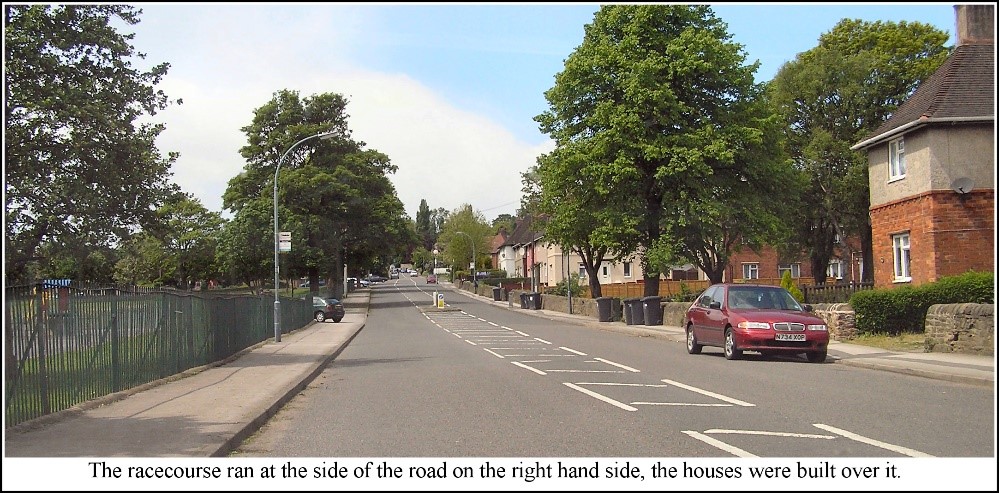
Stand Road. This was clearly the track initially made to access the race stand. The stand was located at the top of where the park is now. Some people think that this was actually the racecourse itself. However, the map at the top of this page shows it ran adjacent to the course. This area is where the gardens of the houses are on the right-hand side of Stand Road today.
Racecourse Road. This was actually part of the course, the highest part being where it crosses St. Johns Road; from here it was all downhill to the back of Pottery Lane.
 Whittington-History