THE LORDS OF THE MANOR AND PRINCIPAL LANDOWNERS.
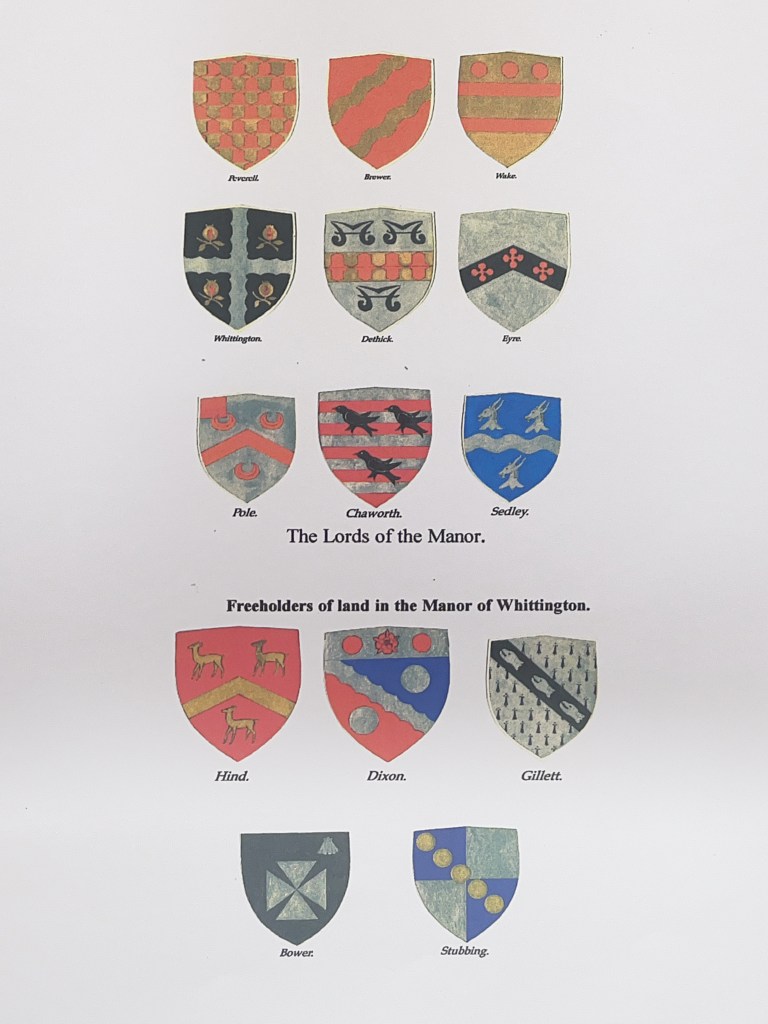
The history of any Parish is always influenced by its Lord and principal landowners. Below is a list of the main people who it is believed to have owned the Manor of Whittington over the centuries.
1086. William Peverell. William the Conqueror gave him the Scarsdale Hundreds, which was most of the land in the Peak District of which Whittington was a part.
1204. William Brewer. One of King John’s advisors.
1233. Baldwin Wake.
1275. Robert Whittington, and the heirs of this family.
1295. Robert Dethick. and his heirs.
1422. Henry Pole of Hague in North Notts. and his heirs.
1708. Chaworth, Fryth and Sedley.
1790. John Dixon, he gradually bought land from the previous owners.
1816. Henry Dixon.
1856. William Fowler, and his heir.
1884. William Parker Esq.
1893. The Trustees of the late William Parker. From here the land was sold off in lots. The principal owners being Great Stoke Estates.
William Peveril the younger was accused of poisoning the Earl of Chester. His lands were then confiscated and taken back to the crown by Henry the 2nd, who then gave them to Prince John.
In 1204, King John gave the whole of the Scarsdale Hundreds to William Brewer, the judge. This land was split up approx. 1233 between 5 sisters (co-heiresses) when William the younger died. (Brewer family crest)
Isabelle Brewer, one of the sisters, was married to Baldwin Wake, her share of the land included Chesterfield, Brimington and Whittington.
Approx. 1270, Whittington seemed to be owned by a family of that name, who probably took their name from the manor. I might add that very little is known of the family, except that Robert Whittington had a coat of arms. They must have acquired the land from the Wakes about this time.
Alice was given Whittington. She was the ward of Peter de la Pole of Radburn. Alice married his third son, Henry. This was approx. 1422 and they made their home at Hague in North Nottinghamshire. The Pole family owned Whittington for nearly three centuries. The last of the male line, George Pole, died in 1681.
Only the Whittington’s lived in the Manor during the early years. The other owners held Whittington as an area of land. In most cases, they lived quite a distance away. John Dixon was the next Lord to actually reside here. During the early years it appears that Whittington was closely associated with Brimington and Chesterfield. In fact, the owners of these two manors seemed to be involved in the administration of Whittington. These were the Bretton’s, Loudham’s and Foljambe’s. Their shields were displayed in the windows of the old church. (See the chapter on the Norman Church)
Up to 1570, Whittington was still mainly in one piece, but in a document from the Scarsdale hundreds dated 1633 there were five freeholders in the manor,
These being:
Nicholas Sprentall. Richard Lowe, Francis Renshaw, Godfrey Stubbing. John Somersall, (Possibly there were others.)
At this point some land in the manor began to be privately held and therefore sold by the Pole family.
George Pole lived at Heage in North Notts, his grandmother was Mary Wright of Longstone. His daughter Elizabeth married Patrick Chaworth of Annesley in North Notts. His other daughter married William Fryth. It appears that Whittington belonged mainly to the Chaworth’s, although Sir Charles Sedley may have inherited some land. Sadly the 2nd Charles Sedley died without children.
THE EARLY FREEHOLDERS OF WHITTINGTON.
At the present time some of the early freeholder’s gravestones can still be seen in the old Church yard. These families owning vast areas of land in Whittington.
The Stubbing family was very wealthy and may have lived at the manor house. The family originated from Broughton in Derbyshire. One of the male line was a Bachelor of Physics.
The Lowe family owned a large piece of land that included the corn mill on the river Whitting, (the one at the bottom of Broomhill Road.) One of this family came from Staveley Forge, and therefore may have been related to the Lowes who started the Staveley coal and Iron Company.
John Renshaw was a rope maker and sold land to a John Allwood of Chesterfield in 1641. Allwood was a tanner and sold land to John Bower in 1677.
The Sprentall’s was also a wealthy family. We don’t know much about them. A Nicholas Sprentalls gravestone can still be seen in the churchyard.
The Hind Family.
John and Rebecca Hind would have come to Whittington about 1650-60, buying a large piece of land on the West Side (the moor, Whittington hill and Sheepbridge). He also had some land in what is now New Whittington. I would imagine that this land being bought from the Pole family, the Hinde’s coming from the Notts area. One of the Hind’s who lived at Laxton in Notts., had the coat of arms shown. The family was very large and is difficult to sort them all out; their large gravestones can also be seen in the old church yard. I might add that John Dixon’s first wife was Elizabeth Hind, she died very young.
In the 1841 census there were an Elizabeth and Ellen Hind, who were living with George and Edward Marr, these were gentleman coalmasters. Samuel Hind was the last of the male line, he died in 1809; the land went to trustees for the children, who were Mordecai and Thomas Binney. To support the children the land was gradually sold off, John Dixon being the principal buyer.
The Gillett family.
This was another large wealthy family in the village during the late 1600’s, Thomas coming from London with his younger brother Richard. They were the owners of the Manor House and farmlands approx. 1675-80. There were many Thomas’s and Richard’s over the generations of this family.
The Webster family.
There were many Websters living in the village in the late 1600’s one line of this family becoming quite wealthy and provided the first school in the village. A Godfrey Webster bought land in Whittington from Thomas Eyre of Holm Hall approx. 1680.
John Dixon.
John Dixon became very wealthy, and with the money that he acquired from his Glasshouse and Coalmines, bought land in the Manor. Eventually becoming the principal landowner and Lord of the Manor, gradually piecing the land of Whittington together again. Even when he made his will in 1816, he was negotiating buying land from a Webster and Cundy and wished that these purchases should go on after his death.
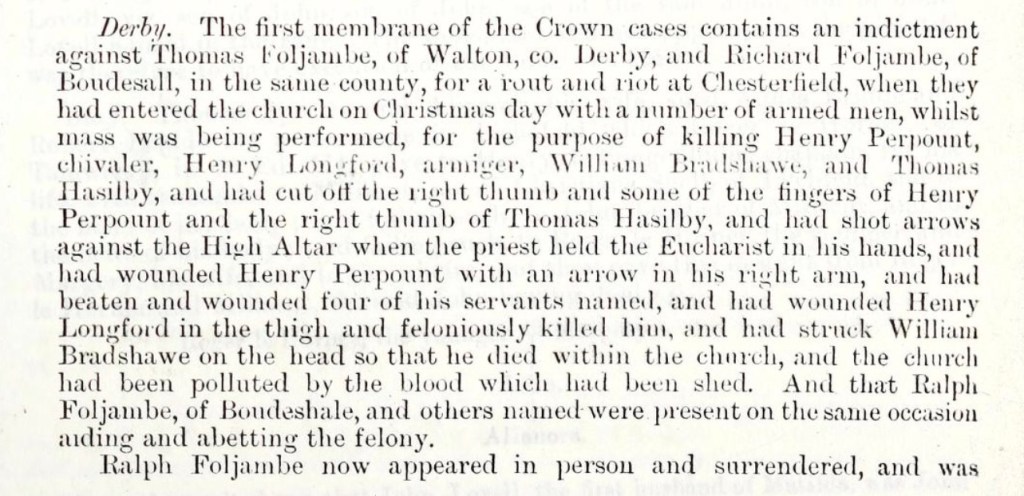
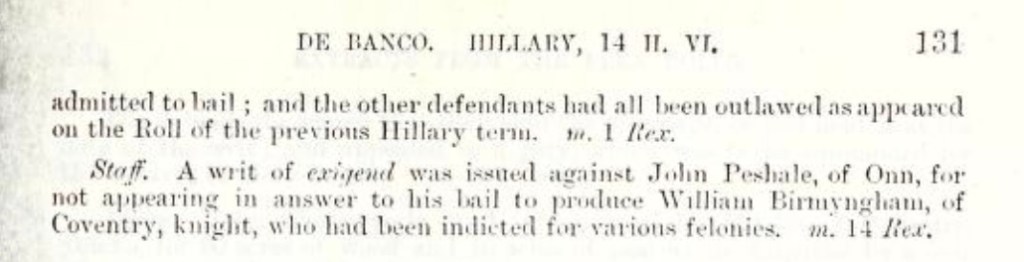
An interesting story I have come across involves two of those named. Thomas Foljambe and Sir Henry Pierrepont. It appears that both were keen to accumulate land around Chesterfield and were aggressive in their dealings. There is a record of plead rolls in the Collections for a History of Staffordshire (Staffordshire Record Society, 1900) New Series Vol. 3, Page 130 which records an indictment against Thomas Foljambe of Walton and others for a rout and riot in Chesterfield. On Christmas Day 1434 they entered the Parish Church in Chesterfield (assuming the Crooked Spire) with the intent of killing Henry Pierrepont and his men. It is said they entered on hearing the sanctuary bell being rung as the Priest elevated the Bread in preparation for Holy Communion. They fired an arrow into the Altar and attacked Henry who lost a thumb and a number of fingers and was hit by an arrow in his leg. Two of Henry’s men, Henry Longford and William Bradshaw were killed.
I understand that when the case eventually came to court the blame was apportioned to Henry Pierrepont.
 Whittington-History